How VCs Allocate Reserves for Follow-On Investments
Rising valuations are straining reserve models designed for cheaper rounds.

Every VC writes two checks in their head before your seed round closes. The first is the number on the term sheet. The second, quieter one is the reserve, the capital set aside for your future rounds, and it's usually two to three times the first check. That reserve gets budgeted before your next raise is even a line on your calendar, and founders who treat follow-on capital as a reward for good performance are misreading the mechanism. It's portfolio construction, governed by fund math that has nothing to do with how much your team likes you. It's portfolio construction, governed by fund math that has nothing to do with how much your team likes you, and founders negotiating without understanding that math are negotiating blind.
How funds are built to hold reserves, the two main construction strategies
Institutional LPs ask about reserve strategy before they wire a dollar into a fund. It's one of the first diligence questions, because the answer shapes everything downstream: check size, portfolio breadth, ownership targets. None of this gets improvised round to round. It's locked in at the fund's inception, baked into the model the GP pitched to its own backers.
Two approaches dominate, and they produce genuinely different funds. "Percentage of the fund" starts with the reserve: the GP decides upfront that 40 to 60% of committed capital goes to follow-ons, then works backward into initial check sizes and how many companies the fund can hold. "What's left" runs the math in reverse. Pick a target portfolio, say 40 companies, size each initial check to hit roughly 10% ownership, total the cost, and whatever survives fees becomes the reserve pool. On a large fund, that residual usually lands closer to 40%, thinner than what funds get to when they start from the reserve side. The order of operations changes the entire fund. Start with the reserve and you get fewer, better-protected bets. Start with ownership targets and you get a wider bet with thinner backup, and most founders never find out which kind of fund they raised from until the follow-on conversation actually happens.
Data on reserve behavior across fund managers suggests that most cluster around a roughly 1:1 ratio of initial capital to reserves. A fund that reserves 60% for follow-ons is, by definition, putting less into initial checks. That means smaller opening tickets and usually less room to negotiate pro-rata terms later. None of that gets decided at your term sheet. It's set before your company was ever a line in the pipeline. Vintage matters too: funds raised before 2022 typically deployed 47 to 60% of total capital within the first two years, so a lot of that early capital is already spent, and what's left for follow-ons depends entirely on how disciplined that GP was early on.
Rising valuations quietly breaking outdated reserve math
The percentages haven't moved much. The dollars behind them have to stretch a lot further, and that gap is where most reserve models have quietly stopped working, usually without anyone at the fund updating the spreadsheet that says otherwise.
Seed median post-money valuation hit an all-time high in Q4 2025, well above the year before, which was itself above the year before that. Series A tracks the same climb, with median post-money rising sharply year over year to a new high in the same quarter. A fund that set its reserve ratio when seed rounds cleared at a much lower valuation is now applying that same 2x or 3x multiple against a price half again as high. The follow-on dollar buys meaningfully less ownership than the model assumed it would, and nobody adjusted the model.
AI sharpens the problem instead of softening it. AI companies now capture 42% of seed capital, concentrating follow-on demand in a narrower slice of the portfolio, so a reserve sized before a fund made an AI bet is very likely undersized for what that company will cost to defend in the next round. Funds that haven't rerun their reserve math against current pricing find that out exactly when it hurts most: when a portfolio winner needs the capital and the fund doesn't have enough of it left. A stated reserve ratio tells you nothing about actual capital available. Ask directly how much of the fund is left, and how current pricing has changed what they can actually commit.
How VCs filter their portfolio into follow-on tiers, and the factors that determine which tier you're in
Reserve allocation at the fund level is a budget. Deployment at the company level is triage, and the two run on entirely different logic.
At the early stage, growth velocity decides almost everything. Initial checks and broad portfolios don't leave room for a nuanced read on product quality or team depth this early, so VCs play a momentum game, chasing whichever companies are growing fastest because that's the only signal they trust at this stage. At later stages, the scorecard flips: the question becomes whether the company is tracking to the plan it pitched at the prior round. SaaStr's analysis puts a number on it. Companies within 25% of their projected plan two years post-investment carry roughly a 70% chance of returning 5x or more. Miss that band and the odds fall off fast.
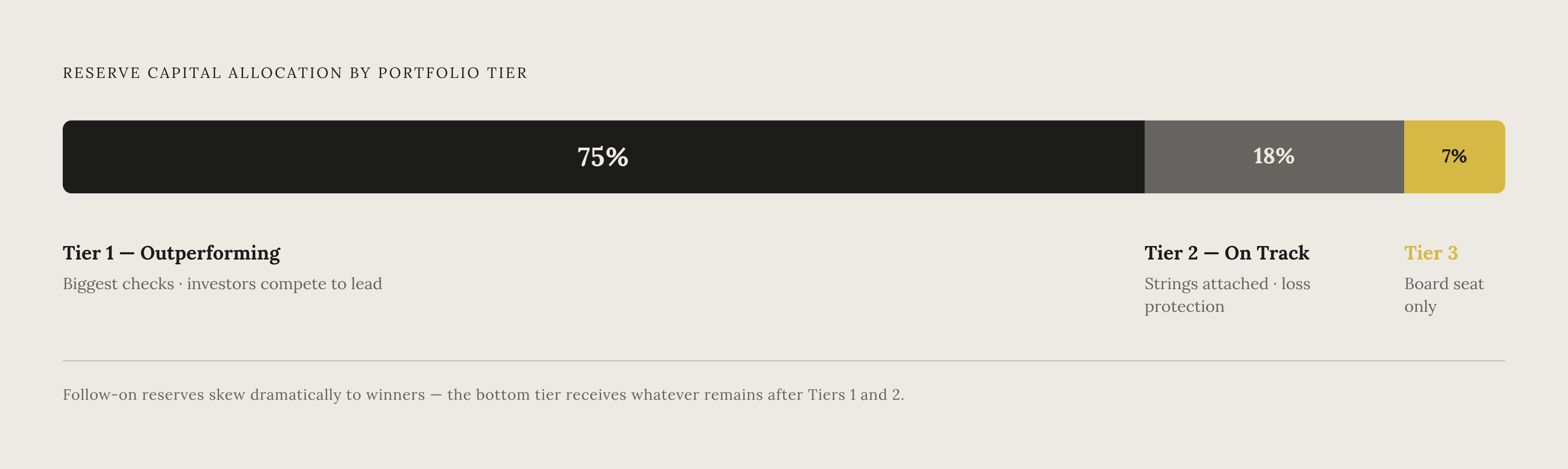
A three-tier framework common in the SaaStr community maps cleanly onto how reserves actually get spent. Companies executing on or ahead of plan absorb 70 to 80% of available reserves. These are the founders who get bigger checks and investors competing to lead. The middle tier, not failing but not standing out, gets 15 to 20% of reserves, usually with more strings attached, money meant to protect against a total loss rather than chase more upside. The bottom tier gets whatever's left, mostly just enough to keep a board seat and avoid marking the position to zero. A founder handed a token follow-on check should read it correctly: that's a hedge, not a vote of confidence, and no amount of warm language on the call changes what the check size is telling you.
Even with tiers in place, the process isn't purely quantitative. Sunk cost thinking and plain attachment to a deal are recognized distortions in follow-on calls. The more disciplined shops counter this with a Follow-on MOIC framework, which asks a blunt question: what's the expected return on the next dollar into this specific company. Kauffman Fellows has written about this framework as a check against emotion-driven allocation decisions. The stakes on getting it right have gone up too, because attrition has gotten worse. Only 30 to 35% of seed-funded companies now reach a Series A, down from roughly 50% during the 2018 to 2021 run. VCs build their triage knowing a large share of the portfolio simply won't get that far.
What non-participation signals to the market, and when it becomes a self-fulfilling problem
When an existing investor skips their pro-rata, incoming investors read it as information. The insider with the most access to your numbers chose not to add capital, and that's a hard signal to talk around, whatever the actual reason behind it.
The reality is usually messier than the signal suggests. A fund might be out of reserves, past its investment window, or boxed in by something at the fund level that has nothing to do with your company. But new investors doing diligence can't easily tell "this fund is out of dry powder" from "this fund saw something it didn't like." So they ask more questions, diligence slows, and terms or valuation compress even when the business is performing fine.
Series A is where this bites hardest. At that stage, it's often genuinely unclear whether a company is heading toward a breakout, so the information edge a VC is supposed to hold hasn't resolved yet. Non-participation carries outsized weight precisely because nobody, including the investor declining to write the check, knows for certain they're right to pass. Inside rounds, funded entirely by existing investors with no new lead, cut both ways too: they can read as conviction, or as proof that no outside investor wanted the deal. Founders who let that ambiguity sit unaddressed hand the market's most cynical read a clear runway.
The fix is sequencing. Founders should know, before launching a round, whether existing investors intend to participate and at what level. Finding out mid-process does far more damage than building the narrative ahead of time. That matters more now than it did a few years back: the median company that raised a Series B in Q1 2025 had waited 2.8 years since its Series A, the longest gap on record. That's a longer window for existing investors to make the call, and a longer window for a fund's reserves to sit tied up waiting on it.
The structural risk of reserves: why doubling down on winners can still hurt fund returns
Reserves quietly inflate how much capital a fund is actually managing. A GP who commits a substantial sum to initial checks and runs a 1:1 reserve ratio isn't managing that sum anymore. They're managing, and need to return, roughly double it.
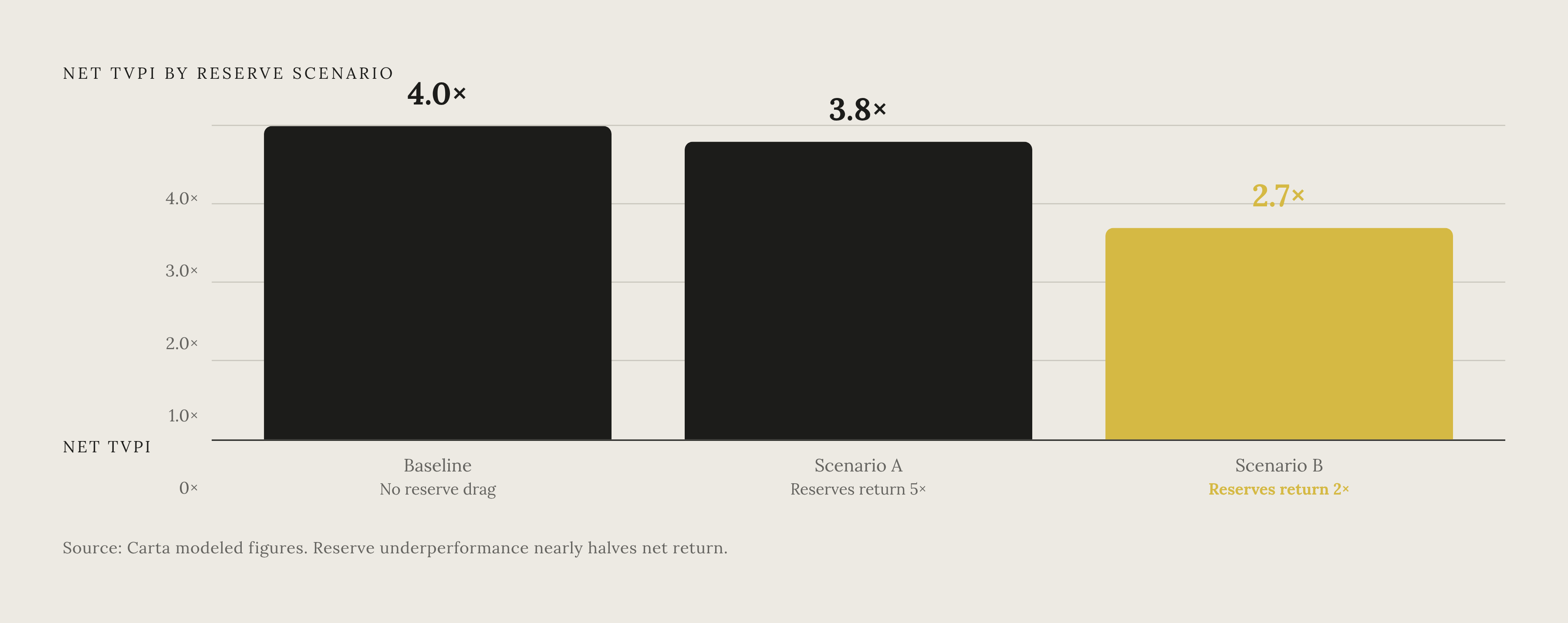
Carta has modeled what that costs. If reserve capital generates a strong 5x aggregate MOIC, carry rises, but net TVPI still slips, from 4.0x down to 3.8x. If reserve capital only manages a 2x aggregate, the damage gets much worse: net TVPI falls from 4.0x to 2.7x. Reserves are additional capital at risk, full stop, and if that capital underperforms the fund's first bets, it drags the whole return profile down even as carry ticks up.
Early-stage venture runs on a power law, and that should decide how reserves get spent, not just how much of them exist. In Carta's analysis of 5x-plus funds, the top-performing company in the portfolio averages roughly 90x MOIC. The second-best manages about 25x. Everything else, on average, returns roughly 1x. Reserve strategy only pays off if the GP correctly identifies which company sits in that top slot and concentrates capital there, a much harder task than any framework makes it sound, and most GPs will admit privately they don't know which company that is until it's already obvious to everyone else too.
Greylock's early Series A check into AppDynamics, a modest sum by later standards, returned roughly 100x. The later checks, several times larger combined across subsequent rounds, returned 14.5x, a strong outcome on its own terms but far weaker on a dollar-weighted basis than the original bet. Clint Korver at Ulu Ventures draws the policy conclusion directly from this pattern: for early-stage funds with a limited capital base, putting more money in at seed and Series A is usually more return-efficient than holding large reserves for later. Funds that over-reserve at the early stage turn themselves into late-stage funds without a late-stage fund's capital base to match. Emerging managers who under-reserve run the opposite risk, burning through capital before their next fund closes and getting diluted in exactly the companies that deserved more support. Spreading only 10 to 15% of a fund toward follow-ons across a wide portfolio rarely moves the needle either way. Call it the worst of both approaches: not enough to defend a winner, not small enough to free up capital for more first checks.
Current market environment's implications for follow-on availability at each stage
Capital is shifting later and toward AI, and both trends are squeezing reserve budgets at the early stage right now. In 2024, annual cash raised grew 78.8% at Series D and 82% at Series E and beyond, while Seed and Series A fundraising declined. That's capital moving away from precisely the stages where reserve triage matters most.
AI is soaking up a disproportionate share of what's left. AI companies now capture 42% of seed capital, up from 23% before ChatGPT's release, and 35.5% of Series A capital. Funds with heavy AI exposure are burning through reserves faster, at higher prices, which squeezes what's left for the non-AI bets sitting in the same portfolio. Layer on the seed-to-Series A collapse, down to 30 to 35% of companies graduating from roughly 50% during 2018 to 2021, and funds are effectively reserving against a longer tail of companies that won't make it. That's dead weight eating into reserve capacity no matter how carefully GPs try to model around it.
Pricing tightens the vise further. Series A median pre-money valuation hit a new high in Q1 2025, up 9% year over year, even as the number of closed Series A rounds fell 10%. Fewer deals at higher prices force follow-on checks to get bigger just to hold the same ownership percentage, straining reserve budgets that were never sized for this environment. The follow-on landscape isn't purely offensive capital anymore either. Just over 19% of new rounds closed in Q1 2025 were down rounds, a pattern holding since early 2023, and structured terms, liquidation preferences, participation rights, are back in the term sheet in ways they weren't a few years ago. Seed deal count fell 28% year over year in that same quarter even as valuations climbed, meaning GPs are making fewer initial bets. That can leave more reserve capacity per surviving company, but it also raises the cost of being wrong on any single one.
Reserve logic as an intelligence layer in founders' fundraising process
Knowing which tier you sit in before launching a round changes how you run that round. Ask existing investors directly about their follow-on intent. The answer decides whether you walk into new investor meetings with an anchor already in place or with a gap you'll be explaining on the spot.
Fund age matters as much as fund size. A fund in year five or six that deployed heavily early, with pre-2022 vintages often putting 47 to 60% of capital to work in the first two years, may simply have little left to reserve, regardless of how well your company is doing. That's arithmetic reflecting how much capital is left to reserve.
Treat investor participation as something to manage rather than something to find out about. Pre-round conversations with existing investors let a founder shape the story new investors hear, instead of reacting to a gap once diligence has already started. At seed, remember growth velocity is the variable your investors actually watch, not product polish, not narrative. If growth isn't putting you in the top tier of the portfolio, reserve capital drifts elsewhere, and you should honestly ask whether your investors are still excited by your trajectory or simply holding the position open until the mark can be justified.
At Series A and later, plan execution takes over as the scorecard. The 25% threshold turns your internal tracking of plan versus actuals into the primary lens your investors use to decide which tier you land in, not merely a management tool for your own team. Learn also to tell a defensive check from an offensive one: a small bridge from an existing investor who declines to lead or expand their position is a signal that something has shifted, not an occasion to celebrate.
The gap between rounds has stretched considerably. The median seed-to-Series A interval now runs 774 days according to recent industry data. Founders have to hold investor relationships across a much longer runway than the 2021 market ever assumed was normal. Reserve conversations shouldn't wait for the formal process to open. Start them early, while there's still time to shape the outcome instead of reacting to it.