Vintage Year Effects on VC Deployment Pace
Founders who ignore a fund's vintage year chase investors structurally closed for business.

A fund's vintage year is not a filing detail. Treat it as one and you're the reason so many founders burn weeks pitching partners who have no room left to say yes. Vintage year sets the entry prices a fund paid, the pace it's willing to write checks at right now, and whether the person across the table can actually move on your deal. Founders who read vintage and lifecycle position the way institutional allocators do stop chasing warm intros to funds that are, structurally, closed for business. That's the whole argument. Everything below is the mechanics of why.
Vintage year is defined by a fund's first capital call or first investment, not the date on its formation documents. A fund that finishes paperwork in November but doesn't call capital until January carries the January vintage. That distinction matters because vintage year is shorthand for an entire operating environment: the valuations a fund paid to get in, how many other funds were bidding on the same term sheet, where interest rates sat, what the exit market looked like once the fund needed to sell. Cambridge Associates, Burgiss, and Preqin all publish returns by vintage year rather than pooling every fund together, because stacking a 2020 fund against a 2022 fund on raw IRR mixes up two different games. Skill in one fund can't be judged fairly against luck in timing in another, and conflating the two is the single most common mistake founders make when sizing up a potential investor.
The venture literature calls this path dependency: a fund's return doesn't accrue smoothly like interest in a savings account, it gets made in sequence. Prices paid going in. Whether a portfolio company received follow-on capital when it needed it. Whether the exit window was open or shut when the fund needed liquidity. Vintage year is the label for which combination of those variables a given fund is living through right now, early and hungry for new deals, mid-portfolio and picky, or in harvest mode and mostly done writing checks.
How concentrated venture returns are across vintages
Venture returns don't spread evenly across time. Not close. Roughly 80% of total venture returns have come from just 22% to 30% of vintages, meaning 5 to 7 vintage years out of 23 measured account for almost all the value the asset class has ever created. Push further and it gets starker: 95% of returns trace back to just 6 to 10 of those 23 vintages.
That's not a story about bad luck. Landing in a weak vintage is a mathematical headwind that no amount of stock-picking skill fully offsets. A manager who bought in at inflated prices, with a shrinking pool of follow-on capital and a closing IPO window ahead, is fighting arithmetic, not competitors, and arithmetic doesn't care how good your diligence memo was.
That arithmetic changes behavior directly, and it does so without anyone issuing a memo. A manager sitting in a structurally weak vintage, high entry prices behind, a narrow exit runway ahead, slows down on its own. The bar for new deals rises. Reserves get hoarded for follow-ons instead of spent chasing new logos. None of that is passivity: it's a fund protecting what capital it has left because the math leaves no other option. That's the direct link between a fund's birth year and the pace a founder feels sitting across the table during a pitch.
What the 2019–2022 vintage spread shows about how entry conditions drive deployment behavior
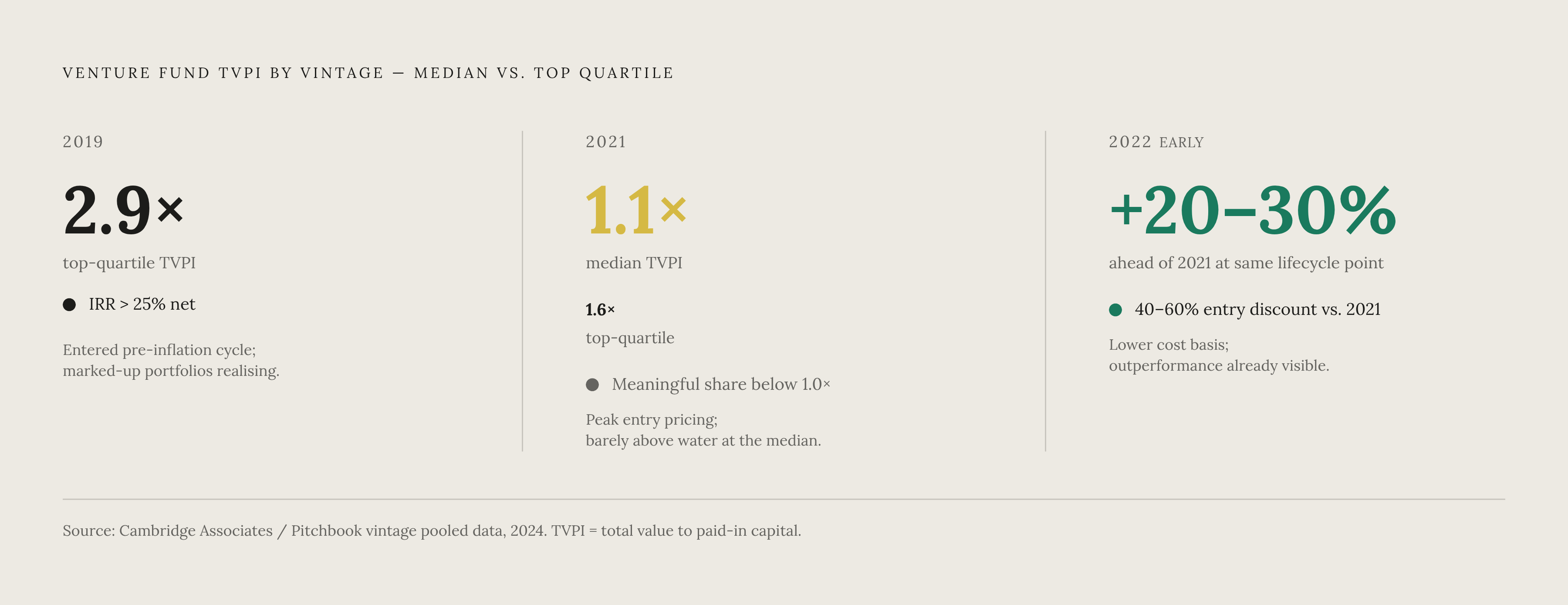
The 2019 vintage is the case study in getting the timing right. Data from Cambridge Associates, Preqin, and Carta show that as of the first half of 2025, top-quartile 2019 funds were tracking around 2.9x TVPI with net IRR above 25%. The 2018 vintage did even better: top-quartile TVPI near 3.1x, net IRR above 27%. Those funds bought in before valuations peaked, had years for portfolio companies to mature before exit markets froze, and still found reasonably priced follow-on capital when they needed it.
2021 is the counter-case, and fund size explains most of the damage. US venture funds raised $168 billion that year, roughly 1.9 times more than the prior year. Early-stage valuations jumped 64% year over year, landing 124% above their five-year average; later-stage valuations rose 93% from 2020, sitting 150% above their own five-year average. Funds paid 20x-plus ARR multiples just to get a seat at the table. Median 2021 vintage TVPI is now around 1.1x, top quartile near 1.6x, and a meaningful share of funds haven't cleared 1.0x at all. That's the vintage to be skeptical of if you're pitching it today: the managers are still marking down positions they overpaid for, and that changes how they behave in a room.
2022 is the inflection point. Funds deployed that year bought in at a 40% to 60% discount to 2021 peak pricing, and early performance data already has the 2022 vintage outperforming 2021 at the same point in its life by 20% to 30%. Call 2022 the buy-the-dip class. Managers who entered after the reset, with disciplined pricing and far less competition for term sheets, are playing a better hand than the vintage sitting one year ahead of them, and that gap is why a founder should care more about a fund's entry year than its brand name.
The difference shows up in the room, not just in the spreadsheet. A 2021 vintage manager sitting on markdowns and a stalled exit market behaves differently in a pitch than a 2022 vintage manager holding fresher entry prices and a longer runway, even when it's the same general partner running both funds. Same person, different fund, different incentive. Founders who miss that distinction are pitching the calendar year instead of the actual decision-maker.
How deployment velocity shifted across vintages, what the Carta data shows
Deployment data across vintage years from 2017 through 2025 traces the mood of each market almost year by year. In year one, 2021 vintage funds had already deployed 35% of committed capital, a frenzied, FOMO-driven pace that in hindsight reads as a warning sign, not confidence. The 2024 vintage deployed only 25% in its own first year, and 2023 vintage funds were more conservative still. Slower here reflects deliberate caution. It's the market correcting itself in real time.
The 24-month mark makes the slowdown impossible to miss. The 2020 vintage deployed 60% of committed capital within 24 months, the fastest of any cohort measured. The 2022 vintage deployed only 43% in that same window, the lowest of any vintage tracked as of early 2024. Dropping from 60% to 43% signals a structural shift. It's a structural reset in how carefully managers approached new bets once the 2021 excess became obvious to everyone.
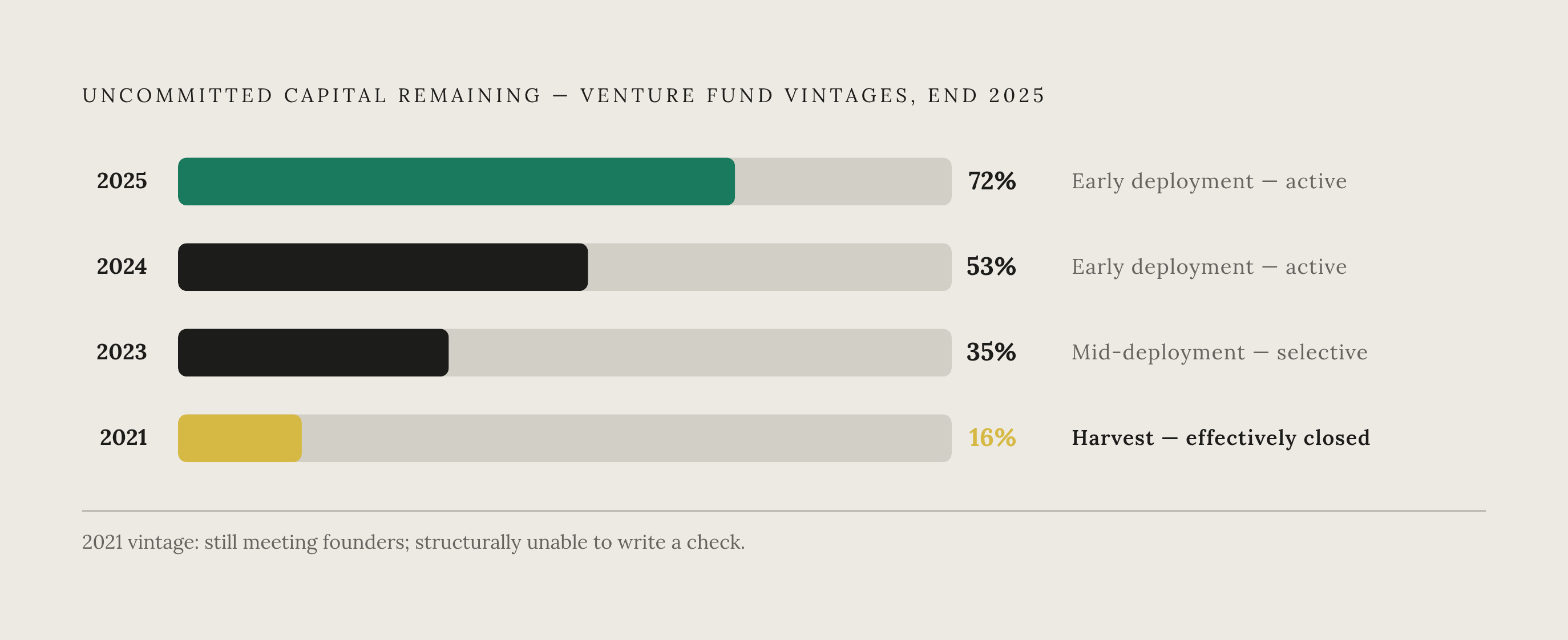
Dry powder remaining by vintage, as of the end of 2025, is the forward-looking half of the picture. The 2025 vintage still held 72% of committed capital unspent. The 2024 vintage had 53% remaining, 2023 had 35%, and 2021 had spent down to just 16%. Stack the three most recent vintages together, 2023 through 2025, and they're sitting on more than $19 billion in unspent capital in that sample alone.
IRR trajectories for the hardest-hit vintages are climbing the standard J-curve now. 2021 median net IRR has crossed into positive territory at 1.4%, and 2022 is 0.7%. Every vintage from 2017 through 2020 shows net IRR of at least 4.2%. The practical lesson: reserve ratios determine when a fund actually hits its ceiling, well before headline deployment percentages get anywhere near full. A fund that's set aside 20% to 30% of its capital for follow-ons is functionally closed to new names long before its reported deployment figure says so.
What the global dry powder buildup and LP dynamics mean for which funds are open for business
Industry reports point to global private equity dry powder reaching multi-trillion-dollar levels by early 2026, with US VC dry powder running into the hundreds of billions entering 2025. Big totals in aggregate, deployed with growing selectivity underneath, and the aggregate number is close to useless to a founder without knowing the age of that capital.
Age is what determines how close dry powder actually is to spending. PitchBook data show that by the second quarter of 2026, roughly half of all private market dry powder sat in funds between two and five years old, close to the record 54.4% set in the first quarter of that year, and higher than what followed either the 2008 financial crisis or the dot-com bust. Funds in the 2022 and 2023 vintages are working through their investment periods, the contractual window during which a fund can make new investments before it has to hand uncalled capital back to LPs. That deadline creates real urgency, and it tends to speed up decisions for founders whose deals fit the thesis.
The pressure shows most clearly in fund formation. Industry data on new VC fund commitments through the third quarter of 2025 showed a sharp pullback from prior-cycle highs. LPs aren't getting cash back from older funds, so they're slower to commit to new ones: VC fund close rates fell to multi-year lows in 2025, the worst of any fund type tracked, and first-time managers are reporting meaningfully longer timelines to close than in prior cycles.
Secondary markets are absorbing some of that pressure. Secondary transaction volume reached roughly $160 billion in 2024, with volume continuing to grow. GPs, LPs, and even founders are turning to secondaries for liquidity that IPOs and M&A aren't providing right now. The trillion-dollar dry powder headline, on its own, tells a founder almost nothing. What matters is which vintage cohorts control that capital, where those funds sit in their own lifecycle, and whether LP pressure is pushing a given manager to move faster or slower.
How the current market's concentration in AI funding reshapes what "active deployment" looks like by stage
The fourth quarter of 2025 alone reached roughly $141 billion in global VC funding, a 12% jump quarter over quarter. That headline hides where the money actually went, and the answer is almost entirely one sector. AI accounted for more than 26% of total global VC funding in 2025, up from 15% in 2024 and just 7% in 2023. Strip AI out of those numbers and most of the "recovery" evaporates on the spot, which is the point most headline VC coverage still gets backwards: this isn't a broad market recovery, it's one sector absorbing the capital that used to spread across many.
Capital is also piling into fewer hands than it used to. Capital is concentrating at the top of the market, with a growing share of US VC dollars flowing to a small number of high-valuation companies compared to earlier in the decade. SVB calls the posture "surgical." Fewer deals, bigger checks, conviction stacked at the very top of the market instead of spread across it.
Stage-specific numbers show the bar rising even as total dollars flow in. Seed round sizes and post-money valuations climbed in the fourth quarter of 2025, even as seed deal count fell sharply, a pattern of rising valuations alongside shrinking deal volume. Series A rounds have repriced meaningfully from 2021 peaks, and investors are demanding clearer evidence of traction before committing. Early signs of product-market fit no longer clear the bar.
For a founder outside the AI premium, fund lifecycle shifts from a footnote to the whole conversation, since a disciplined 2022 vintage fund with fresh dry powder and a looming investment-period deadline puts a founder in a completely different position than a 2021 vintage fund still managing markdowns and an impatient LP base. Raising from a disciplined 2022 vintage fund with fresh dry powder and a looming investment-period deadline is nothing like pitching a 2021 vintage fund still managing markdowns and an impatient LP base. The effect appears starkest in graduation rates: only 15.4% of seed startups from the first quarter of 2022 reached a Series A within two years, versus 30.6% of the first-quarter 2018 cohort. The tightened capital environment doesn't just slow deals down. It cuts a meaningful share of companies out of the pipeline for good.
How to read a fund's vintage year and lifecycle position before you take the meeting
Founders rarely ask a fund what vintage it's raising from or where it sits in its own deployment cycle, and that's a missed opportunity, not tact. According to Startups.com, that information is usually shared freely the moment it's asked for directly in conversation. It costs nothing to ask, and it's one of the most underused questions in a fundraising process.
Four lifecycle positions cover most of what matters, and they are not equally worth a founder's time. Funds in early deployment (2024 and 2025 vintages) still hold 53% to 72% of committed capital unspent and carry the strongest appetite for new positions, though entry pricing now runs more disciplined than it did during 2021. Funds in mid-deployment (2023 vintage, roughly 35% remaining) stay active but grow choosier, at the point where reserves for follow-ons start competing directly with capacity for new deals. Funds in late deployment (largely 2022) are racing investment-period deadlines, which creates genuine urgency for founders who fit the thesis even as the bar for a brand-new position climbs. Funds in harvest phase (2021, only 16% of capital remaining, median IRR just turning positive) are effectively closed to new checks. Meetings can still happen, but the person across the table usually can't move, and founders burning weeks chasing that room are misallocating their own scarcest resource.
A handful of concrete signals sort a fund's real position faster than the vintage label alone. Pricing discipline is the first: a 2022 vintage fund that bought in 40% to 60% below 2021 peaks is likely calibrated to today's lower entry multiples, and probably more realistic about where 2026 valuations should land than a 2020 vintage manager still anchored to pre-reset expectations.
Distribution activity is the second, and it cuts against intuition. More than half of 2020 vintage funds have started returning capital to LPs, generating some DPI, while only about a third of 2021 vintage funds have reached that point, and 2022 and 2023 are just under a quarter, based on fund performance data through the fourth quarter of 2025. A fund generating distributions carries less LP pressure, which sounds like good news for a founder pitching it. Except that same signal usually means the fund is tilting further into harvest and further away from writing new checks, so treat a healthy DPI as a yellow flag, not a green one.
None of this replaces thesis fit, check size, or stage fit. It sits alongside those filters. A fund that matches perfectly on thesis but sits in the wrong lifecycle stage is still a low-probability meeting, no matter how warm the introduction was. Founders who map their target list by vintage, estimated remaining dry powder, and recent deal cadence turn what's usually a guessing game into something closer to an actual pipeline, built on the same signal institutional allocators already use to pick managers in the first place.
Sources
- Why fund vintage matters and how timing shapes venture outcomes
- Vintage Year: definition, the fund-cohort metric, and why 2020-2021 vintages look so different from 2022-2024 | Startups.com
- VC Fund Performance by Vintage: 2019–2022 Returns
- valueaddvc.com
- US PE/VC Benchmark Commentary: First Half 2025 - Cambridge Associates
- chronograph.pe
- pitchbook.com

