How Reference Calls Actually Influence VC Investment Decisions
Investors often decide deals on reference calls the founder never sees.

Reference calls are an active filter that can kill a deal in its final week, not a confirmatory step that rubber-stamps a decision already made. Founders tend to picture fundraising as a sequence they control: pitch, data room, a short list of references, term sheet. The actual sequence runs differently. Every founder is selling during a raise, and investors know it, so they spend the reference process testing the distance between the founder's version of the company and what the market will independently confirm. A small gap reads as normal optimism. A gap that keeps widening across call after call reads as a founder who cannot be trusted to self-report, and that reading kills term sheets that looked settled a week earlier. This filtering function has gotten stronger, not weaker, as funding conditions tightened: confirmatory diligence carries more weight now than it did in 2021, and reference calls are doing more of that work than before. What follows traces how that filtering operates, across three distinct tracks, most of which never pass through the founder's hands.
How diligence starts before the founder knows it
The riskiest reference calls happen before a founder is ever asked for a reference. By the time an investor sends a formal diligence request, that investor may have already talked to several people adjacent to the company, since informal diligence runs alongside the formal process from the start. Portfolio founders in the same space, operators who've worked the sector for years, co-investors from an earlier round, advisors, recruiters, strategic partners, anyone who has watched the company from an angle the founder didn't arrange: all of these people are potential inputs long before a reference list exists. A founder walking into a first meeting with a strong informal reputation already has a head start. A founder whose market reputation is shaky or inconsistent will often find the investor simply slows down, with no real explanation offered, because the hesitation came out of a conversation the founder never knew happened and was never invited to address.
The market holds memory the same way a data room holds documents. Customers remember whether an implementation went smoothly or turned into a mess. Former employees remember whether direction from the founder was clear or whether the company lurched from one priority to the next. Advisors remember whether a founder actually listened to what they said or just collected a name to drop in a deck. In tighter sectors, this memory moves fast. Health is a good example: the pool of serious specialists is smaller than founders tend to assume, investors compare notes with each other as a matter of course, and something said in one corner of that market can reach another corner within days.
The practical consequence is that reputation is something a company is generating all the time, whether anyone is thinking about fundraising or not. Every customer interaction, every employee's exit, every advisor conversation is already building the reference record an investor will eventually tap into, long before a term sheet is on the table.
The three formal call types
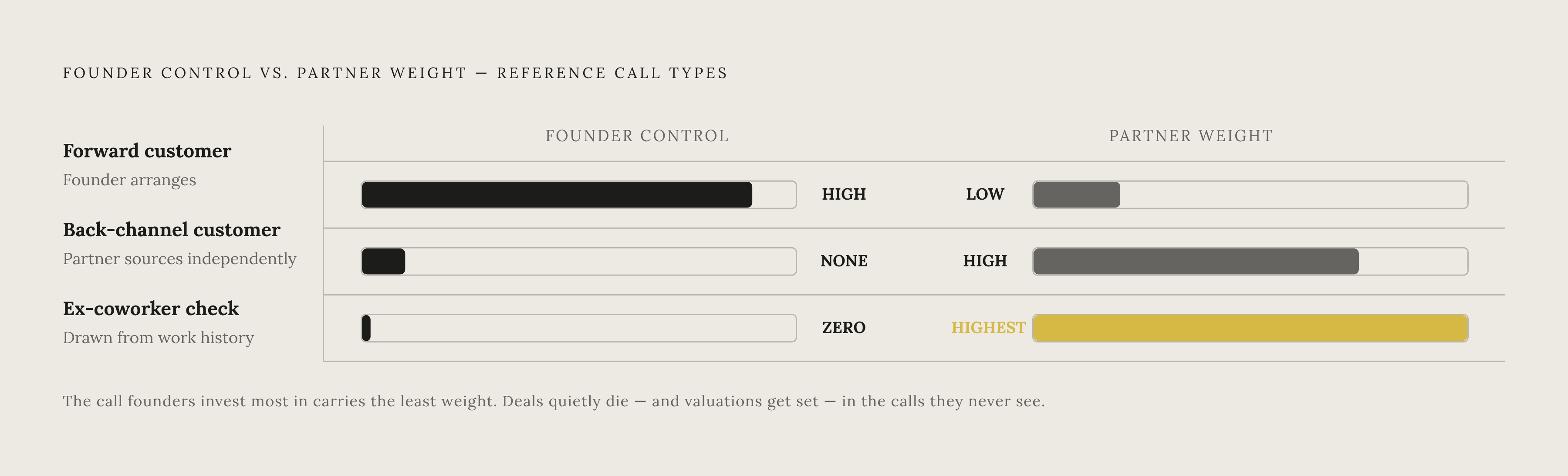
Once a deal moves into formal diligence, the reference process breaks down into three distinct types: the forward customer call the founder arranges directly, the back-channel customer call the partner sources independently, and the ex-coworker check that reaches people from the founder's past who were never on any list. Partners weight these three in close to reverse order of how much control the founder has over them. The call a founder spends the most energy preparing, the staged forward reference, is the one carrying the least weight in the final decision, because the partner already knows it's staged and discounts it accordingly. That doesn't make it worthless. Partners often push harder on specifics in these calls precisely because they expect a polished answer and want to see what's underneath it.
The back-channel customer call works differently. A partner finds these contacts through personal LinkedIn connections, through founders already in the portfolio, through design-partner relationships, through peer investors, with no script and no advance warning to the company. A partner might call a user who signed up two weeks ago, or dial the CTO at a logo sitting prominently on the pitch deck who, it turns out, never converted to a paying customer. The ex-coworker check pulls from a different well entirely: people from the founder's professional past who speak to character.
Across a typical deal, a partner makes somewhere around 10 reference calls over the course of a diligence process that runs many hours, and most of those calls happen without the founder in the room or even aware they're taking place. That single fact should reset how founders think about reference prep. The call they can stage is a minority of the actual work. The two call types that follow, both of which operate largely outside the founder's visibility, are where the real judgment gets formed.
What the back-channel customer call is actually testing
The back-channel customer call is where deals quietly die and where valuation often gets set, because it's the one reference type a partner treats as close to fully unfiltered. These contacts come from the partner's own network, not the founder's: personal LinkedIn connections, other founders in the portfolio, design-partner relationships, peer investors the partner already trusts. The founder has no visibility into who gets called or what gets asked.
A forward reference who says only positive things doesn't reassure a partner, it triggers more scrutiny. Answers that sound coached or generic read as a signal that something is being managed rather than disclosed, so the partner goes looking for an unfiltered source to balance it out. A founder who offers up a champion who hasn't actually been in touch for months, someone who has quietly drifted neutral on the product, is handing the partner a reference that will likely come back negative, without meaning to.
What's at stake in these calls extends to the terms and oversight that follow the deal. Research on referred deals in VC networks finds that reference quality shapes both the size of the round and how much monitoring follows the investment: referred deals see a notable rise in round size along with reduced post-investment monitoring, a pattern most visible among small traditional venture firms. A strong, unfiltered reference network functions as leverage on valuation and on how closely an investor watches the company afterward, beyond serving as a gate to getting a check.
The good news for founders is that most of this is recoverable if handled before the call happens, not after. Surfacing a known weak spot directly with the partner, flagging an uneven churn cohort, naming a customer who went quiet and explaining why, before the partner finds it independently, tends to read as honesty. The same fact, discovered cold by a partner working a back channel the founder never anticipated, reads as concealment. The information is often identical. The sequencing is what decides how it lands.
What the ex-coworker check surfaces
The ex-coworker founder check moves the diligence process away from the product and toward the person, testing honesty, coachability, and behavior under pressure, the things an investor needs to understand before money moves, drawn from people the founder never selected and cannot brief in advance. This is the track founders have the least ability to shape: the contacts come from a work history the founder can't edit or brief in advance.
What gets listened for in these calls can outweigh what gets said, since a pause before someone says "yes" can tell a partner more than a five-minute monologue of praise, because hesitation is hard to fake and easy to notice. One question in particular does a lot of work here: whether there's anything the reference would only mention if asked directly. That question is built to open a door, to a co-founder dispute that never made it into the pitch, a team departure that got smoothed over in the telling, an HR issue the founder hoped had stayed buried.
Four things get tested across these conversations. Honesty: do the references corroborate the specific stories the founder told in the pitch, or do the details diverge? Coachability: does the person on the other end describe someone who takes hard feedback and does something with it, or someone who deflects? Respect: the praise can be specific and personal, or it can carry the formal distance of someone describing a person they merely tolerated. And failure mode: every founder has a weak spot, and the investor wants to know what it is before wiring money.
A pattern of defensiveness, exaggeration, or burned relationships appearing across these calls is close to a guaranteed way to lose a deal that otherwise looked strong. Integrity and honest self-awareness surfacing in the same calls tends to do the opposite. As with the back-channel customer call, the fact that does the most damage is rarely the fact itself. It's the fact discovered without context. Naming a known weak spot directly with the partner ahead of time is almost always recoverable. The same information discovered independently almost never is. The clearest preparation for this part of diligence is the last five years of how the founder actually treated the people around them, which is the record these calls are built to retrieve.
Building the reference list that holds up to a backchannel audit
Once the three tracks are clear, the only one a founder genuinely controls is the named list, and that list deserves to be built like a strategic document rather than assembled from whoever answers the phone fastest. The composition itself sends a signal. A list stacked with friendly peers and no one who held authority over the founder, or vice versa, tells a partner something was curated too carefully.
A few categories carry real weight. A former manager or board member, one or two of them, matters because that person evaluated the founder under a formal structure rather than choosing to be associated with them, and someone who survived a real power dynamic with the founder is a stronger data point than a peer who simply liked working alongside them. A former direct report, also one or two, is arguably the single most revealing category on the list: how a founder treats people who report to them, people with less power in the relationship, tends to be a more honest signal than how that same founder performs for a boss. A paying customer decision-maker, again one or two, should be someone who actually bought the product and can speak to whether it delivers, not a friendly champion who agreed to the call as a favor. A co-founder or long-term business partner, one person, speaks to how the founder holds up in hard moments over time. A prior investor is optional, and should only make the list if that investor genuinely likes the founder, because a lukewarm reference from a past investor can do more damage than leaving the category empty.
The full list should run five to eight names offered up front. In practice, a partner will typically call three to five of those and then ask for one or two names the founder didn't provide, which is the moment the back-channel track quietly takes over.
Briefing a reference well is different from coaching one. Give the reference the partner's name, the fund, and a single sentence on the thesis of the deal, enough that the customer understands who's calling and why, without handing over the pitch itself. Share the three things being positioned, the use case, the outcome, and the metric, as a frame. And include a recent miss alongside a recent win when briefing a reference, because the miss carries more weight than the win: a reference who has nothing but good news tends to trigger the exact back-channel escalation a founder is trying to avoid. Staying in touch with top customers on a regular basis means any complaint reaches the founder before it reaches a partner. No customer who hasn't been spoken with recently should make the list. Confirming each reference well in advance matters too: a same-day reschedule is the kind of thing partners notice and remember. After each forward call, ask the customer what the partner pushed hardest on, since that question usually points to where the rest of the diligence memo is headed next.
Why warm VC-to-VC referrals slow due diligence
Founders tend to assume a warm introduction from one investor to another shortens the road to a term sheet. The research runs the other way on a specific point: the stronger the relationship between the referring investor and the one receiving the referral, the longer the due diligence process tends to run, not shorter. When two investors are closely tied to each other, the investor making the referral is putting their own credibility on the line, and the investor receiving it feels a heavier obligation to get the call right, so the response is more scrutiny.
What a warm introduction does change is different from what founders usually hope for. It raises the odds of clearing initial screening, and it correlates with larger round sizes once a deal actually closes, along with reduced post-investment monitoring, mainly among small traditional venture firms. A warm intro buys a seat at the table faster. It does not buy a shortcut through the reference checking that follows, and founders who treat the introduction as having done that work already tend to get caught off guard once the back-channel calls start.
That sits alongside the point made earlier about timing: diligence doesn't begin when a formal reference request lands in a founder's inbox. Informal and market-level diligence is very often already underway before that request ever arrives, warm introduction or not. The three tracks, informal market reputation, the back-channel customer call, and the ex-coworker character check, run on their own timelines, largely outside the founder's control. Understanding how each one actually works is the only real defense a founder has against being blindsided by a term sheet that quietly disappears in its final week.
