What Kills a Deal After a Term Sheet Is Issued
Operational gaps and unverified claims are the real deal killers after signature.

A signed term sheet changes what can kill a funding deal. The investor moves from interest to risk, testing whether the company can support its claims and close cleanly. Most post-signature failures arise not from a sudden change of mind, but from gaps in operational readiness. Protecting the deal therefore starts before signature, while founders still have time and leverage to resolve those gaps.
What a signed term sheet actually is — and what it starts
Most founders feel the deal is done when they sign. That confidence can become a liability. It encourages management to treat the work still to be done as paperwork, even though the investor has not yet made a legally enforceable funding commitment. Valuation, investment amount, and governance terms are almost always non-binding at this stage. Signature establishes the basis for completing a transaction.
The obligations are not symmetrical, however. The no-shop clause, confidentiality provisions, and expense-allocation clauses, where included, are generally binding right away, while the commercial agreement still has conditions to be met. The founder grants exclusivity in exchange for an expression of intent. Between signature and wire, four to six weeks of legal drafting, deepened diligence, syndicate fill, and closing conditions can run simultaneously.
That distinction also makes the term sheet more than a disposable outline. Delaware courts have ruled that binding provisions can stay in force after definitive agreements are signed, even when those agreements have integration clauses. Precision about which provisions are superseded is therefore a legal necessity.
Why diligence after signing is structurally different from diligence before it
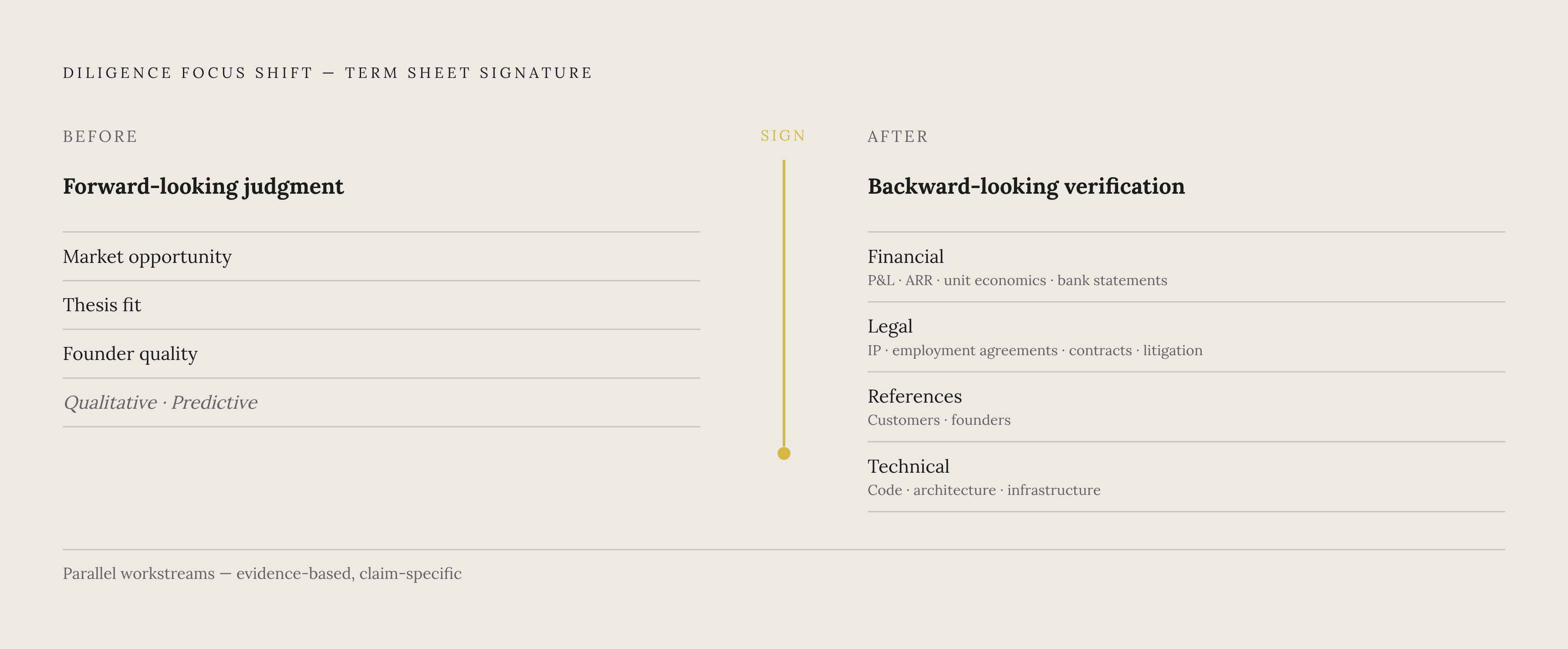
Before signature, diligence largely tests the opportunity. The investor assesses the market, thesis fit, and founder quality through a qualitative, forward-looking judgment. After signature, the work becomes backward-looking and evidence-based. The investor now principally tests whether the company’s specific claims withstand verification and the transaction can close without surprises.
This verification proceeds through several parallel workstreams. Financial diligence examines the P&L, ARR build, unit economics, and bank statements, while legal diligence covers IP assignments, employment agreements, material contracts, and litigation. Customer and founder references test relationships and leadership, with technical diligence added where applicable. Even with a convincing pitch, each workstream needs records to back it up.
The intensity of that transition varies by investor. Some do much of their diligence before they issue a term sheet, so the work afterward is mostly to confirm what they have found. Others sign quickly and leave the hard checks for the exclusive period. Founders cannot always tell from the term sheet itself which approach an investor will take.
Investor experience adds another source of uncertainty. Traditional VCs that regularly complete startup investments have an established diligence cadence, while less experienced venture investors may lack one. That difference affects how well founders can predict the process after signing, even when both investors sound equally sure at the start.
How diligence findings become the leading cause of collapsed deals
Diligence findings become deal-killers when assertions cannot be verified or reconciled. The business need not be fundamentally broken. Financial diligence is a common point of failure because discrepancies between the pitch deck, financial model, and audited or bank-verified figures turn a question about numbers into a question about credibility. An isolated inconsistency may be explainable, but repeated inconsistencies make the explanation harder to accept.
Discrepancies often arise from differences in definition. ARR may include revenue from professional services, customer counts may include accounts that have churned, or growth rates may be based on periods that do not match. Each figure can appear defensible in isolation while giving the investor a different picture when compared with the underlying records. Preparation can expose those differences before they become discoveries made by the investor.
Customer concentration presents a related risk. Revenue that depends on one customer, government program, or contract type gives the investor a single-point-of-failure concern that a headline growth figure may obscure. Beyond financial review, environmental, legal, regulatory, and operational findings account for a growing share of collapsed deals, widening the preparation burden.
The founder usually knows about the underlying financial issues. The preventable failure is leaving them unexplained until diligence reveals them independently. Early disclosure separates a known limitation from an apparent misrepresentation.
Cap table problems and IP gaps that stop a close
A cap table that does not reconcile is among the most common legal obstacles to closing. Co-founders who have left may still hold equity that was never bought out, early angels may have non-standard rights, and even shareholders with small stakes may need to give consent. These are not merely spreadsheet errors. They can determine whose cooperation is needed before the financing can proceed.
Cleanup may therefore become a closing condition. A problem identified early can be resolved as preparation, while the same problem found late introduces uncertainty during exclusivity. Legal work that could have happened before the raise instead competes with the closing deadline.
IP gaps create a separate chain-of-title problem. Proprietary Information and Invention Assignment Agreements, or PIIAs, document the assignment of inventions and related rights to the company. Missing agreements from founders or employees leave ownership of core intellectual property open to challenge. A contractor who built core technology without signing an IP assignment can create a gap investors regard as unresolvable within a normal closing window.
Investors may hold off on funding until the gaps in that chain are closed. During a 30-to-45-day no-shop period, the delay consumes time without moving the company closer to cash. Cap table audits, PIIA sweeps, and contract assignment reviews should be completed before the term sheet, when remediation can proceed free of exclusivity deadlines.
How governance ambiguity and unresolved control questions create late-stage collapse
Governance disputes arise when conceptual agreement meets definitive language. A term sheet may establish board structure or consent rights without specifying the voting thresholds and protective provisions that make them operative. Drafting exposes the assumptions left unresolved. By then, exclusivity is running and both sides have already incurred significant legal fees.
Veto rights over future financings illustrate the problem. The parties may agree that investor protection is reasonable but disagree over the scope of the actual restriction. Consent requirements for executive hires and terminations, or approval thresholds for material contracts, can produce the same friction. The parties can still renegotiate, but big changes after signing use up goodwill and can make an otherwise sound deal look shaky.
Unclear leadership creates a more fundamental obstacle. Co-founder disputes, ambiguous CEO authority, or shared control arrangements can leave the investor uncertain about who will run the company. References or drafting may expose that uncertainty only after commercial terms appear settled. The investor can then pause or withdraw despite agreement on valuation.
Closing on unfavorable terms is not necessarily a satisfactory resolution. Full-ratchet anti-dilution, uncapped participation, and excessive veto rights can deter future investors and constrain operating flexibility. The strongest negotiating window is before the no-shop begins. Meanwhile, management that issues hiring offers, signs vendor contracts, or models runway as though funding has arrived can create a liquidity crisis if these negotiations extend the close.
How the no-shop clause creates a structural trap when the close runs long
The no-shop makes every delay more consequential. Diligence findings, governance disputes, and slow syndicate formation can consume the exclusive period while the founder cannot solicit or negotiate with alternatives. As runway shrinks, the investor gains more power to bargain.
Runway determines how severe that exposure becomes. A 30-day no-shop poses a different risk to a company with two years of cash than to one with eight weeks. Identical contract language can therefore have very different operating consequences. The shorter the cash buffer, the less room the founder has for work that slips.
Even with preparation, the syndicate can still fail. If the lead cannot assemble enough capital for the agreed round, the company may need to close on less or wait longer. A partner departure, a portfolio write-down, or a change in the lead investor’s own fundraising position can also disrupt the transaction after signature. The founder has little control over these developments.
The response is to reduce exposure before accepting exclusivity. Founders can negotiate a shorter no-shop where possible, assess the investor’s record of closing signed term sheets, and map a co-investor fill list in advance. A structured raise cannot prevent conviction drift or market changes, but it can shorten the window in which those risks strike.
Why the investor's reference check phase catches what financial diligence misses
References test the relationship behind the recorded transaction. A customer can confirm revenue while challenging the founder’s account of satisfaction, renewal prospects, or product performance. Financial records do not settle those questions. Treating calls as a formality leaves founders unprepared for a distinct layer of verification.
A customer who felt oversold may describe a relationship very differently from the pitch. A contract presented as renewed may prove to be month-to-month, or a supposed champion may turn out to be a detractor. Such differences become credibility concerns. They can add to doubts that have already come up elsewhere in diligence.
Professional references extend that test to the team. Founder judgment, co-founder alignment, and leadership stability may look different in conversation than in formal documents. A deal that cleared financial review can still stop when references reveal unresolved control or leadership problems.
Founders can prepare without trying to script the evidence. The task is to know which customers will be called, brief them honestly on the investment context, and disclose relationship complexity beforehand. A churned account, contract renegotiation, or product issue is better presented with context than left for the investor to discover through a conflicting account.
How AI in the data room is raising the standard for what investors can verify
AI-assisted diligence expands the volume of evidence investors can compare. When there are many documents, it becomes easier to spot inconsistencies that a manual review might miss. The preparation standard rises as a result. A data room must let investors compare documents as well as hold documents that each look plausible on their own.
Hebbia supports cross-referencing revenue figures in a management presentation against audited financials and customer contracts. Its platform surfaces relevant passages from those document types with specific citations. That capability makes the relationship between a claim and its supporting evidence more directly examinable. It also reduces the room for inconsistent definitions to remain unnoticed across separate files.
PwC uses Harvey across its Deals practice, from initial target familiarization to structuring and interrogating virtual data rooms. The work includes source-grounded, citation-backed analysis. AI-assisted diligence also broadens the scope of environmental, regulatory, and operational document review that previously demanded substantial manual effort.
For founders, the response is a different preparation model. Figures should reconcile where they should agree, claims should be documentable, and explanations for differences should already be in the room. AI-powered fundraising infrastructure can help organize and stress-test those materials before investors see them. The advantage comes from applying the same systematic scrutiny to preparation that investors increasingly apply to diligence.
What founders can do before signing to protect a deal they haven't won yet
PIIA sweeps need to cover founders, employees, and contractors who worked on core technology. Cap table reconciliation should address non-standard rights, departed co-founder equity, and shareholder positions that complicate consent. Reviews of material contracts should check the assignment provisions, especially when a contract accounts for a large share of revenue. These tasks belong before exclusivity makes unresolved work expensive.
Financial preparation is a consistency exercise. Pitch metrics should reconcile with the model and the relevant bank statements and customer contracts. Definitions for ARR, NRR, churn, and growth rates should be written down and used consistently. Customer concentration, contract structure, and revenue composition should be disclosed proactively. The answer should exist before the investor asks.
Reference preparation requires the same discipline of disclosure. Customer contacts should understand the context and what to expect, while relationship complications should be surfaced in advance. Co-founder alignment and leadership authority should also be unambiguous. Preparation cannot guarantee a favorable reference, but it can prevent known complexity from arriving as an unexplained contradiction.
Founders should weigh the business case for exclusivity before they accept it. Its length should reflect actual runway, while investor selection should consider closing history, fund lifecycle position, and the lead’s conviction and capital without syndicate dependency. Mapping how much each co-investor will put in before signing can keep the fill phase from using up the exclusive period. More broadly, investor targeting, pipeline management, and data room preparation should operate as recurring disciplines. Their purpose is to leave the post-signature window available for verification and execution, rather than repairs the company could have completed before signing.

