Signs a VC Fund Is Near the End of Its Deployment Period
Founders should check a VC fund's vintage year before pitching.

A venture fund's investment period has a start date and an end date, written into the Limited Partnership Agreement, and once that window closes, the general partner generally cannot write a check to a new company. That's not a discretionary choice a GP makes when they feel cautious. It's a contractual boundary, typically set at three to five years from the fund's start, and it governs what a firm is legally permitted to do with a founder's pitch deck regardless of how much the partner in the room likes it.
Founders rarely check for this before taking a meeting. They build a target list off sector fit and check size, pitch a partner who seems genuinely excited, sit through weeks of diligence, and then watch the deal quietly stall. In most cases, that is a fund that's already past the point where it can lead a new round. It's a fund that's already past the point where it can lead a new round, dressed up in a general partner's enthusiasm because the partner is still managing a live portfolio and still wants to meet founders, just not to write them a first check.
A fund past its investment period is not a dead fund. The typical VC fund runs roughly ten years total, so a vehicle that closed its investment window in year four or five still has five or six years left to manage its existing companies, support follow-ons, and drive toward exits. That's value-creation or harvest mode, and it looks almost identical from the outside to a fund that's actively hunting. The GP still takes meetings. Still posts on social media. Still shows up at the same conferences. A founder can spot the difference only by knowing precisely what to look for, and learning to read it is the whole reason this matters.
The 2021–2022 vintage problem: why so many funds are hitting this wall right now
Do the math on any fund that closed in 2021 or 2022, and as of 2026, it is somewhere inside or just past that standard three-to-five-year investment window. That single cohort is the most common one a founder runs into today, and it happens to be a cohort under unusual strain.
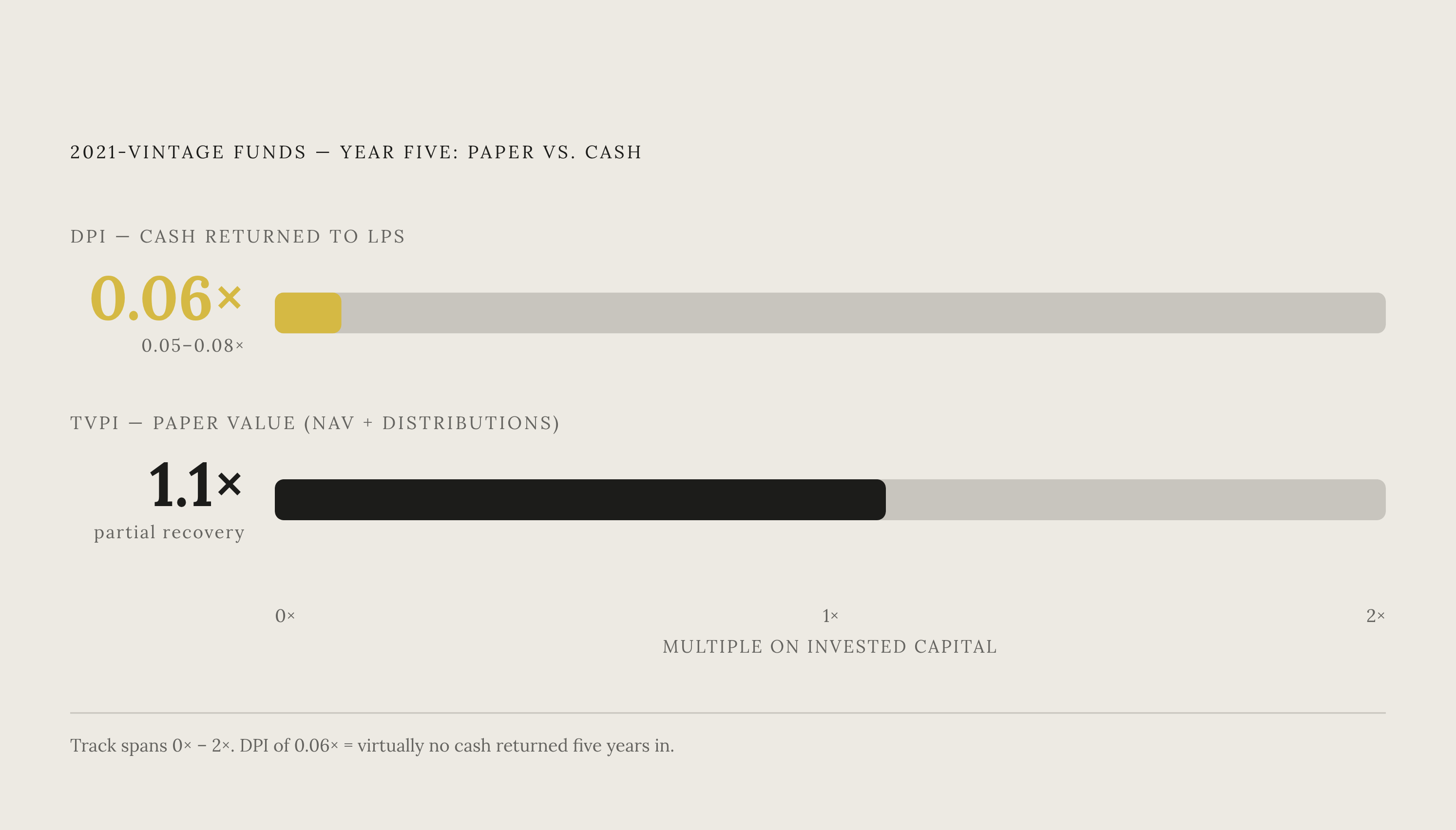
The strain has a name: shrinking cash distributions relative to capital paid in. According to PitchBook and Value Add VC data, 2021-vintage funds are at just 0.05x to 0.08x DPI (distributions to paid-in capital) five years into their life. Paper markups, TVPI, have shown some recovery, but cash actually returned to LPs has not. That gap matters because it means the general partners running these funds are managing two problems at once: a portfolio that's largely unrealized, and a looming conversation with the same LPs about committing to Fund whatever's-next.
That second problem is getting harder. Global LP commitments to new venture funds fell to $118.4 billion in 2025, down from $219.0 billion the year before. A GP walking into that fundraising environment with a 2021 fund still sitting on paper gains and no distributions faces a genuinely difficult pitch, and it pulls their attention toward LP relations and away from sourcing new deals.
None of this means these are bad funds. Plenty of 2021 and 2022 vintages carry strong TVPI and will likely produce real returns over the fund's full life. The issue for a founder is timing. It's timing, and timing is structural.
The most reliable structural signal: how to date a fund and what that age tells you
Vintage year is public information in almost every case: press releases announce fund closes, Crunchbase and PitchBook track them, and SEC Form D filings record them for anyone willing to look. That single data point does more diligence work than most of what founders spend time on.
The heuristic is simple. A fund that closed in 2021 or 2022 and hasn't announced a successor vehicle is approaching, or has already passed, the end of its investment period. That absence of a successor fund announcement is itself informative, since firms typically start raising the next fund while the prior fund is still active, not after it's fully wound down.
Fund age isn't just an operational curiosity, either. A working paper from researchers at the Bank of Israel, Warwick, and Wharton found that investments made earlier in a fund's life were more likely, in their sample, to reach successful exits. The authors point to financing capacity and monitoring horizon as possible explanations: a GP earlier in the fund's life has more remaining capital and more runway to support a company through multiple rounds. Later checks, by construction, come from GPs with less of both.
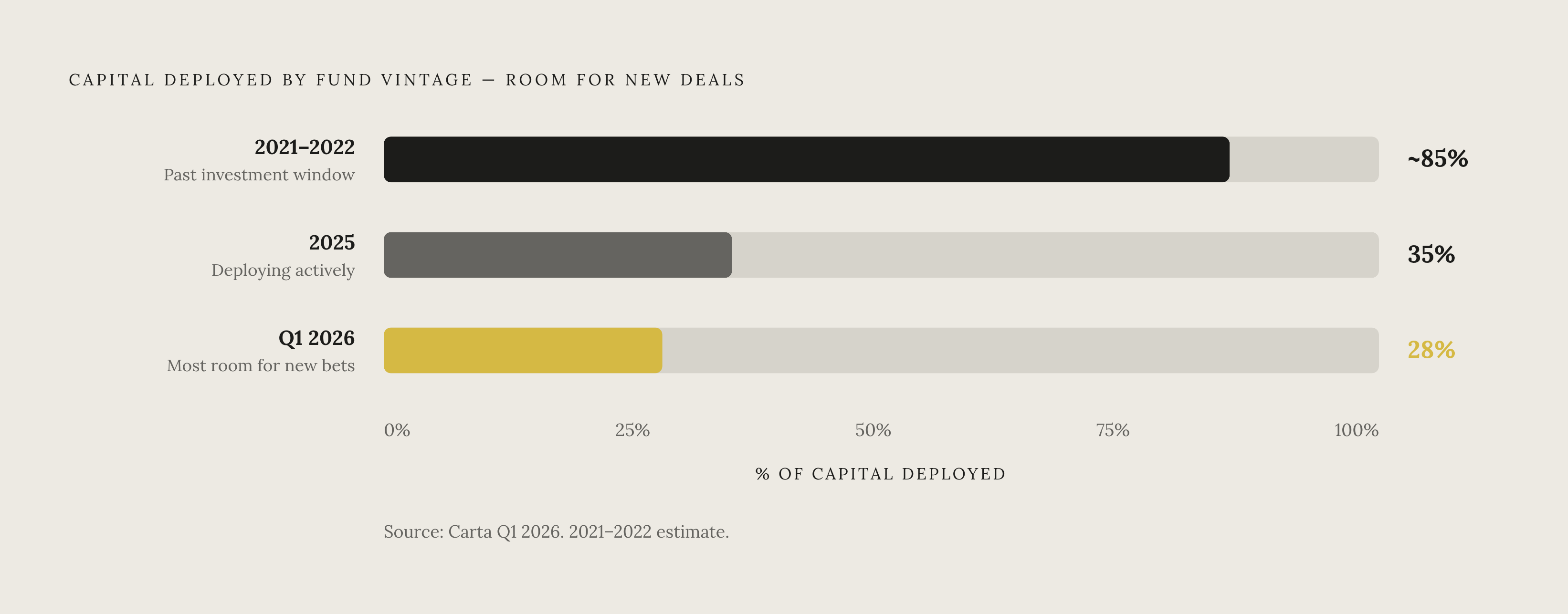
Capital deployed is not the same as capital available. A fund that led headline rounds in 2022 may have committed 60 to 70% of its capital in years two and three of the period, which was normal and by design. By 2026, whatever's left may exist purely as reserves earmarked for follow-ons in companies the fund already owns, not for anyone new.
Contrast that against fresh capital. Carta's Q1 2026 data shows funds that closed in Q1 2026 had deployed roughly 28% of committed capital, while 2025-vintage funds had invested roughly 35%. Those are the funds with real room for a new platform bet. Practically, that means the first filter on any target list should be vintage year, followed immediately by a check for a recently closed successor fund, since that's the clearest public signal of dry powder.
The shift from new deals to follow-ons: what it looks like from a founder's seat
Many funds reserve a substantial share of total committed capital for follow-on investments into companies they already back. As a fund nears the end of its investment period, whatever capital remains increasingly flows toward that reserve pool rather than toward anyone new, which changes the texture of every meeting a founder has with that GP.
Early in a fund's life, a partner meeting a new company tends to ask open, exploratory questions: what does the company do, why now, why this team. Late in the period, the questions shift register. They start sounding like "how does this relate to what we already own" or "we'd need to see X before we could move," language that fits a new company against existing portfolio context rather than evaluating it on its own footing.
Watch the speed differential, too. A GP who moves fast on a bridge round for a portfolio company but goes quiet or slow on new inbound isn't being inconsistent. They're being rational about where the fund's remaining capital is supposed to go, and reserve capital carries far less internal friction to deploy than a brand-new decision does.
A late-period fund that does take on a new deal will sometimes offer an unusually small initial check paired with strong language about future follow-on support. That's not tepid conviction. It's a structural artifact of a fund protecting its reserve pool while still wanting in on a deal it likes.
Recycling provisions add another wrinkle. Some LPAs let a GP reinvest proceeds from early exits back into new deals, usually capped and limited to the active investment period. A fund calling on recycled capital rather than fresh LP capital is a fund whose original investment-period clock is running down, whether or not anyone says so out loud.
Reserve philosophy isn't universal, though, and founders should hold that loosely. Reserve philosophy varies across the industry, and smaller funds in particular may deploy differently from the typical pattern.
The dual-attention tell when a firm is actively raising its next fund
A publicly announced new fund raise is one of the strongest signals available that the current fund has deployed a large share of its committed capital. Firms don't go to market with a successor vehicle while the prior fund still has substantial room for new deals, because LPs would ask why.
Kleiner Perkins raised a new fund in March 2026, with capital split between late-stage growth and early-stage startups, a raise that signals the prior fund had deployed enough to justify going back to LPs. Lerer Hippeau closed Fund IX at a much smaller size in April 2025, focused exclusively on pre-seed and seed across enterprise and consumer. Both examples point to the same underlying mechanic: a closed or newly announced successor fund generally means the prior vehicle has shifted into harvest mode for anything new.
Here's the paradox founders run into. A GP mid-raise on their next fund looks engaged. They're at the same conferences, taking the same meetings, and may genuinely admire your company. But their working attention is split between deploying what's left of the old fund and convincing LPs to back the new one, and commitment decisions require a kind of focus that's in short supply during a raise.
That split attention explains a pattern a lot of founders describe as being stuck "forever in diligence." It's rarely stonewalling. It's a GP with real, divided bandwidth at exactly the moment a decision needs full attention.
Founders don't have to guess at this. Asking directly, "what's the size and vintage of your current fund, and how much has been called and deployed," is a fair, non-confrontational question. If a GP can't answer clearly, that hesitation is itself information.
The concentration of capital at the top of the market makes this worth tracking even more closely. Per the PitchBook-NVCA Venture Monitor, three firms took in 48.1% of all venture capital raised in H1 2026. When that much capital concentrates in a handful of raises, it reshuffles what those firms' current funds can realistically do for a founder walking in the door today.
Four behavioral patterns that reveal end-of-period mode without asking directly
A fund near the end of its period tends to apply weeks or months of diligence to a new company while moving quickly, internally, on follow-ons for companies it already owns. The asymmetry is the tell. Ask a GP how long their last two new investments took from first meeting to term sheet. Compare that to how long their last two follow-ons took. The gap tells you where the fund's real urgency lives.
Deployment pressure in the fourth quarter. An analysis of 132 founder rounds shows the September 5 to 30 window with reply rates spiking to 4x baseline, while the October 14 to November 12 window shows notably faster decisions. Partners want deals closed before year-end for reasons that have more to do with vintage-year accounting than with any particular company's merits. A fund that's been slow all year and suddenly speeds up in Q4 may be responding to that internal calendar pressure rather than newfound conviction, and some growth funds deploy aggressively in December specifically to lock in a vintage-year designation for a deal. That seasonal urgency should be separated from actual strategic interest before reading too much into a fast yes.
Funds near the end of their period become more selective, and not because their philosophy changed. Each remaining check now competes directly against the fund's own follow-on reserve needs, so the opportunity cost of a new bet climbs. GPs start describing their mandate in narrower, more precise terms, which reads as discipline but is really capital scarcity wearing a more presentable outfit.
Fast replies to existing portfolio founders, slow or absent replies to new inbound, is a specific signature, not general market fatigue. If a founder inside that fund's portfolio describes a highly responsive GP while an outside founder is sitting in silence, that gap usually points to a fund stewarding reserved capital for the companies it already backs, not one that's simply busy.
Building a target list that filters for deployment capacity, not just thesis fit
Most target lists get built on thesis fit alone: sector, stage, check size, and every fund inside that box treated as roughly interchangeable. Vintage and deployment status rarely make the cut, and that omission is expensive.
It's expensive because fundraising has real seasonal windows, and wasting them on funds that are structurally unavailable is an asymmetric mistake. Per vcboom.com, the fall window, September 1 through November 15, generates 3.4x baseline reply rates and roughly 1.4x the volume seen in spring. The spring window, April 1 through June 30, generates 3.1x baseline reply rates with a median of just 11 days from first email to first term sheet. Burning either window pitching a fund that's already past its investment period is lost time in the exact stretch when responsive capital is most likely to move fast. It's lost time in the exact stretch when responsive capital is most likely to move fast.
A deployment-capacity filter, run before thesis fit, catches most of this. Prioritize funds closed in 2023 or later, and treat anything from 2021 or earlier as "confirm before engaging" rather than assuming it's active. Check for a recently announced or closed successor fund, since that's a signal the current vehicle has shifted into harvest mode, and if a new fund exists and matches your stage, that's the one to pursue. Look, too, for recent portfolio additions in the last six to twelve months that are genuinely new investments rather than follow-on rounds in existing companies, information that's largely public through press releases and standard deal-tracking sources.
A handful of direct questions do a lot of work early in a conversation without coming across as confrontational: what's the vintage of the fund you'd be investing from, are you actively making new platform investments or focused on follow-ons right now, and what does your typical timeline from first meeting to term sheet look like at the moment. None of these questions accuse anyone of anything. They just ask a GP to state what's already true about their fund's position.
GPs have always held a structural information advantage over founders, simply by knowing their own fund's calendar and cash position. Closing that gap doesn't require insider access. Vintage year, successor fund announcements, and recent deal activity sit in public sources, and platforms built specifically for founders raising venture rounds can now surface fund vintage, deployment pace, and recent activity at scale, cutting down research that used to require a deep warm network or a seasoned CFO to piece together by hand.
The payoff is straightforward. A shorter, better-qualified list of funds with genuine deployment capacity outperforms a wide spray across every fund that fits a thesis on paper. The same discipline that improves how founders write outreach also protects the narrow windows, spring and fall alike, when venture capital is actually in a position to say yes.

