Closed-End Fund Structure and Founder Timing
Understanding fund timelines helps founders pitch to the right GP at the right moment.

Most venture funds are closed-end vehicles: a fixed pool of capital, a fixed term, no ongoing redemptions. That structure runs on a clock, usually ten to twelve years, and where a fund sits on that clock determines how eager a general partner is to meet a founder, how much room remains to negotiate terms, and how long that GP can actually stick around after the check clears. Founders who read the clock correctly are targeting something real. Founders who ignore it are pitching into a context they can't see, and no amount of traction slides fixes that blind spot.
The mechanics matter here, not just the metaphor. Limited partners commit capital, but the fund doesn't sit on it as cash from day one. Capital gets drawn down through calls, usually an upfront tranche followed by further calls as deals close, over what's called the investment period. A fund may hold a first close covering 30 to 50% of its target and start writing checks well before the final close brings in the rest of the committed capital. That overlap window, raising from LPs while deploying into founders, shapes GP behavior in ways worth understanding before a first meeting.
Contrast that with an evergreen or open-end fund, which allows some degree of ongoing investor redemption. That flexibility for LPs comes at a cost: either lower long-term return potential or added liquidity management risk for the manager. The closed-end structure trades LP flexibility for a longer runway to build value. That's precisely why it dominates venture. A fund is a vehicle with an expiration date, not a permanent institution sitting around waiting to write checks forever, and that date drives decisions long before it arrives. Founders who treat every GP meeting as though the fund has infinite patience are the ones who get blindsided later.
The investment period's effect on a GP's urgency and openness to new deals
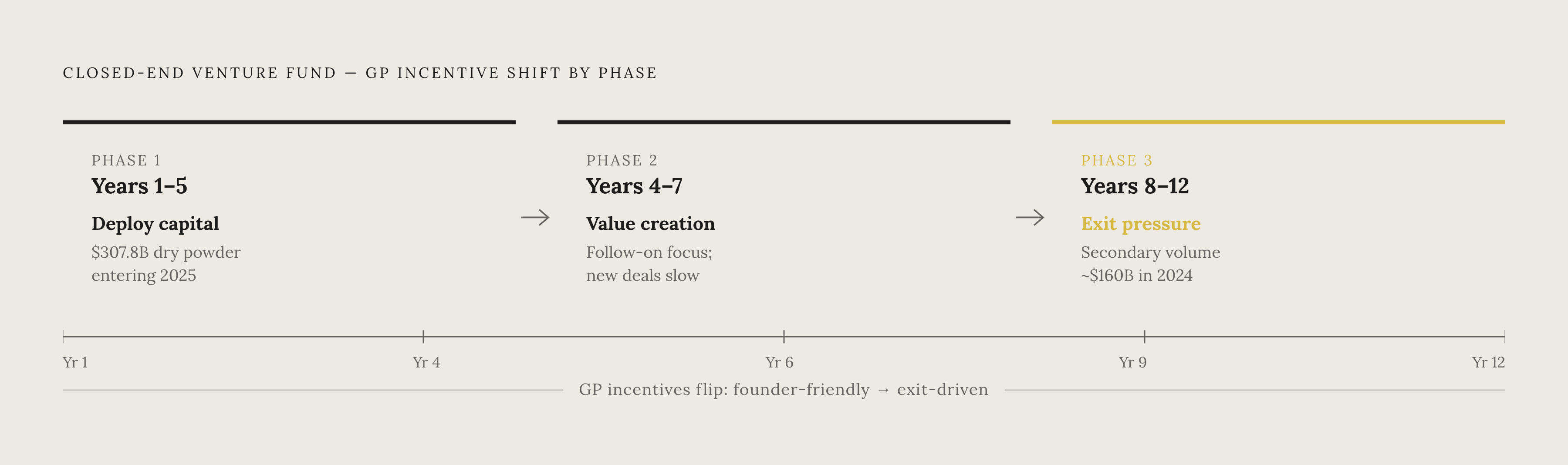
The investment period, typically the first three to five years of a fund's life, is when a GP faces the most pressure to put capital to work and build out a portfolio. Dry powder is sitting there, the investment period hasn't closed, and LPs expect to see it deployed. The NVCA's 2025 Yearbook put venture capital dry powder at $307.8 billion entering 2025: a stack of committed-but-unspent capital sitting inside funds across the industry, waiting on decisions.
Because a fund's first close and final close often don't happen at the same time, a GP may be courting LPs for more commitments at the same moment it's courting founders for deals. New portfolio companies serve double duty here. They're the evidence a GP shows prospective LPs that the fund is active and putting capital to work, which makes this a structurally favorable window for founders getting a first meeting. A GP in year one or two of a new fund has real incentive to see a lot of companies, move at a reasonable clip, and build out a diversified book early.
Recycling provisions extend that window further. Spectup's 2026 analysis of fund structures found that a fund recycling 100% of its fees plus 20% of commitments effectively gains several additional shots on goal across its life, since early exits can get redeployed into new deals instead of distributed straight back to LPs. That's extended deployment capacity across the fund's full term, not a one-time burst early on.
None of this means urgency to deploy translates into urgency to close on bad terms. Early checks set the valuation anchors for the entire portfolio, so GPs in this phase still hold the line on price discipline even while moving fast on volume. And the fundraising environment feeding this phase kept expanding: the VC Corner's tracker recorded $80 billion flowing into domestic venture capital and private equity in the first quarter of 2026 alone, the largest fundraising quarter since 2021. New funds launching at that pace means a fresh wave of GPs entering their own investment periods at the same time, all facing the same deployment clock.
Changes during a fund's mid-life and value-creation phase
Somewhere around years four through seven, the fund's center of gravity shifts. This is the value-creation phase, and the GP's attention moves from finding new deals to supporting what's already in the portfolio: follow-on rounds, board work, introductions, the unglamorous grind of helping existing companies hit the milestones that justify their next raise. New deal activity doesn't stop, but it slows, because the GP's bandwidth is now split.
Follow-on reserves are rarely disclosed publicly, and how much of a fund's remaining capital sits earmarked for existing portfolio companies versus how much is still free for new bets shapes the fund's actual room to act. Founders should ask this question directly, because it tells them something the fund's marketing never will.
There's real research behind why fund age matters here, not just intuition. A 2025 working paper by researchers from the Bank of Israel, Warwick, and Wharton found that investments made earlier in a fund's life were more likely to reach successful exits in their sample, pointing to financing capacity, monitoring horizon, and startup-fund matching as likely explanations. A GP writing a check in year five of a ten-year fund has roughly five years left before the fund needs to start winding down. A founder whose company realistically needs eight years to reach an exit is a structural mismatch with that GP, no matter how strong the business is, and no partner enthusiasm in a first meeting changes that math.
Selectivity rises here because the remaining capital has to be split between protecting existing bets and making new ones, and those two goals compete directly. How much follow-on capacity is actually left, who on the team stays on the board through the rest of the fund's life, and what happens to companies that need more runway than the fund's own clock allows: these deserve direct answers before a term sheet, not after.
Late-fund urgency and its effect on deal terms and founder leverage
Once a fund crosses into year eight or beyond, the mandate flips again. Building gives way to returning. LPs want distributions, and the GP's own carry depends on getting exits done inside the fund's term. GPs this late in the cycle rarely write first checks into brand-new companies. Instead, they're hunting for secondary buyers, nudging portfolio companies toward acquisitions or exits, or negotiating extensions with their own LPs.
Extensions do exist, but they're negotiated exceptions granted case by case, not a default fallback. Exits inside the defined term are the rule in venture, and that constraint runs downhill straight into board meetings, pushing companies toward transacting even when the market or the business isn't quite ready.
For a founder already sitting in a late-fund GP's portfolio, this explains a lot about why board conversations start tilting toward near-term monetization instead of patient compounding. For a founder deciding whether to take a check from a late-fund GP in the first place, the real question is whether the fund's remaining time actually matches the company's timeline: a GP in year seven or eight of a ten-year fund is working with a compressed window no matter how sharp their judgment is.
Secondary markets have become a real release valve here. The Harvard Law School Forum on Corporate Governance reported that secondary transaction volume reached roughly $160 billion in 2024 and is projected to top $210 billion in 2025. Late-fund GPs increasingly lean on secondaries for liquidity. A founder's cap table can shift without the founder driving, or even fully seeing, the transaction. Deal terms coming out of late-fund GPs also tend to reflect that same pressure: a preference for later-stage, lower-risk companies, tighter liquidation preferences, and shorter expected paths to exit. Founders shouldn't rule out late-fund GPs outright, but going in blind to how the fund's own deadline will shape the board table is a mistake founders make more often than they should.
How the emerging-manager squeeze and fund concentration in 2025–2026 change which funds are in which phase
None of this lifecycle framework helps unless a founder can tell what phase a specific fund is actually in, and the current fundraising climate has made that read genuinely harder. PitchBook-NVCA data shows median time to close a VC fund stretched to 15 months, the longest stretch in a decade. A fund announced in the press may be far from actually deploying, since the investment period clock starts at first close, not at the announcement that generates headlines.
Concentration compounds the problem. The top ten funds captured 42.9% of all capital committed through the third quarter of 2025, a record share per that same PitchBook-NVCA series, while the count of emerging-manager vehicles hit a decade low of 177. First-time GPs are stuck fundraising longer, which stretches out their overlap between courting LPs and actually writing checks. The $80 billion that flowed into domestic venture and private equity in the first quarter of 2026 skewed heavily toward established managers, so the funds most visibly in an early, hungry deployment phase right now are disproportionately the large, brand-name ones. The fund most likely to answer a cold email fast is also the one least likely to be a first-time manager still hungry to prove out a thesis.
That leaves fewer GPs genuinely sitting in the early-deployment, high-openness window founders want to target, and the odds of finding one are worse than in prior cycles. The headline growth numbers can mislead too. Industry trackers recorded global venture investment hitting $300 billion across 6,000 startups in the first quarter of 2026 alone, up more than 150% quarter over quarter, and separate data shows over 40% of seed and Series A dollars in 2026 went into rounds of $100 million or more. What looks like GPs broadly opening the spigot is really a small number of enormous checks distorting the total.
Reading a fund's lifecycle position before making contact
Start with vintage year, which is generally tied to a fund's first close and serves as the commonly used reference point for the investment period clock. It's public information, sitting in SEC filings, on Crunchbase, and in the coverage that runs when a fund announces itself.
Investment period length varies by fund but usually shows up in the fund's limited partnership agreement and sometimes gets referenced directly in announcements. Roughly five years is standard for private equity, with venture funds typically running somewhat shorter investment periods. After that window closes, new deal activity gets rationed carefully.
Portfolio density is a useful signal too. A fund targeting twenty companies that has already announced eighteen investments is almost certainly in reserve-management mode, whatever the calendar suggests. A firm posting mostly follow-on rounds and portfolio milestones rather than new deals is telling you, indirectly, that it's mid-to-late in its cycle.
Dry powder can be estimated roughly by taking fund size and subtracting an estimate of deployed capital (deal count times median check size for that stage). It's an imprecise exercise, but directionally useful. At the aggregate level, the NVCA put VC dry powder at $307.8 billion entering 2025, confirming real capacity exists industry-wide, though it says nothing about which specific fund a founder is emailing.
A handful of questions belong in every first meeting. How much follow-on capacity remains in this fund? Is the fund still inside its investment period? Who on the team will actually own the board seat, and for how long? How does the firm handle a company that needs more time than the fund has left to give? None of that is adversarial. It's the same diligence a sophisticated LP runs before committing capital, and asking it signals a founder who understands the mechanics of the business they're raising into. Skipping that work means pitching into a timing context nobody has bothered to check, and a structural mismatch between fund and company causes board tension that becomes visible years after the check has already cleared.
Matching your round's stage and timeline to a fund's remaining runway
Round benchmarks moved fast through 2025 into 2026. Carta's State of Private Markets data shows median seed post-money valuation rose to a notably higher level in the fourth quarter of 2025 compared with a year earlier, with median seed round size reaching $4 million in that same quarter.
The bigger shift is how long it takes to get from seed to a Series A. Industry observers have noted that seed-to-Series-A graduation rates declined meaningfully for recent cohorts, and median time from seed to Series A has stretched well beyond the pace set at the 2021 peak.
That gap matters directly for lifecycle matching. A founder raising seed today who expects a Series A in two years needs a seed investor whose fund still has the runway and follow-on capacity to actually participate in that next round. A fund sitting in year seven of a ten-year term can't credibly promise that, no matter how enthusiastic the partner sounds in the pitch meeting. A Series A raised in 2026 from a fund that closed in 2020, now six years into its term, means the GP has roughly four years before realization pressure starts bearing down on every board decision.
Down rounds made up roughly 18% of all priced rounds in 2025, still elevated against historical norms, and that matters here too: portfolio companies pulling protection rounds eat into follow-on reserves, leaving less capital free for funds in the middle or late stretch of their life to deploy into anything new. Seasonal patterns layer on top of all this. Practitioners broadly observe that mid-January through mid-May tends to be an active window for investor meetings, and fourth-quarter deal volume tends to outpace the first quarter. But good timing on the calendar doesn't override bad timing on the fund's own clock. Founders raising seed should look hard at GPs whose funds are in years one through three. Founders raising a Series A need to confirm the fund's remaining term actually supports a realistic path to exit, rather than forcing a sale before the company or the market is ready.
Turning fund lifecycle intelligence into a structured outreach targeting approach
A fund's position on its own lifecycle clock is a targeting variable, the same way thesis, check size, and sector focus are, and unlike a lot of what founders try to guess about investors, it's knowable in advance. Vintage year, investment period length, portfolio density: all of it sits out in the open before a single email goes out.
Treating fundraising as an operational discipline means building outreach lists around this information rather than around warm intros and hope. A target list sorted by fund phase tells a founder which GPs have genuine incentive to move fast and which ones are managing a portfolio under a shrinking clock. That distinction changes who gets a cold email first, what questions get asked in the first call, and which term sheet gets taken when more than one shows up on the table. The clock was always running. Founders who read it get to use it. Founders who don't find out about it later, usually in a board meeting they didn't see coming.

