How VCs Decide Which Portfolio Companies Get Board Seats vs. Observer Rights
Lead status and investment size predict board seats.

Whether a VC gets a board seat or observer rights follows a predictable pattern based on lead status, check size, ownership thresholds, and who has worked with whom before. Founders who understand that pattern before signing can negotiate to retain control. Investor intelligence, including Metal’s search and meeting preparation tools, can support that work, but the negotiation must cover the whole governance package, including the seats.
Why board seat vs. observer rights is a governance decision
A board seat gives an investor voting rights, fiduciary duties, and legal standing as a director, with authority over executive decisions, exits, and future fundraising. An observer seat grants attendance, document access, and the ability to ask questions, but no vote or fiduciary obligation. Board action runs on majority rule. A founder can own most of the company’s shares and still be outvoted at the board.
HSBC Innovation Banking’s 2025 term sheet analysis found that 91% of term sheets had either a board director or observer provision. Their prevalence can make these clauses look like boilerplate, even though their effects compound across rounds. One investor seat changes the balance of votes, while an observer has a say and a consent right adds another approval the company must get. This incremental transfer of authority is control creep, and understanding it after signing means renegotiating from a weaker position. The allocation of these rights is therefore worth learning as a predictable system before the negotiation begins.
The factors that determine whether a VC gets a seat or observer rights
Lead investor status is the strongest predictor of whether a VC receives a board seat. Amornsiripanitch, Gompers, and Xuan document a positive relationship between lead status and board membership across a comprehensive sample of US and non-US VC deals. VCs receive a seat in a majority of deals they lead and far less often when they participate as co-investors or followers. A request from the lead therefore has a different basis from the same request made by another participant.
Term sheets can make a board seat contingent on a minimum investment or grant observer rights to preferred holders above a specified ownership percentage. The size of the investment and the ownership it purchases help explain the rights requested, while the threshold language determines who qualifies.
Investor type changes that pattern. Corporate VCs and strategic investors take board seats at substantially lower rates than financial VCs, even when leading, often because of liability and conflict-of-interest concerns. An investor can turn down a directorship even with strong leverage and a keen interest in the company. It can instead reflect a preference for information and participation without formal director responsibilities.
Prior relationships are softer variables, but they are not merely anecdotal. Amornsiripanitch, Gompers, and Xuan also identify positive correlations between board membership and prior founder relationships, investor track record, network size, and geographical proximity. A VC who has backed the founder before may seek a seat as a signal of continuing commitment.
How governance structure evolves from seed through Series B
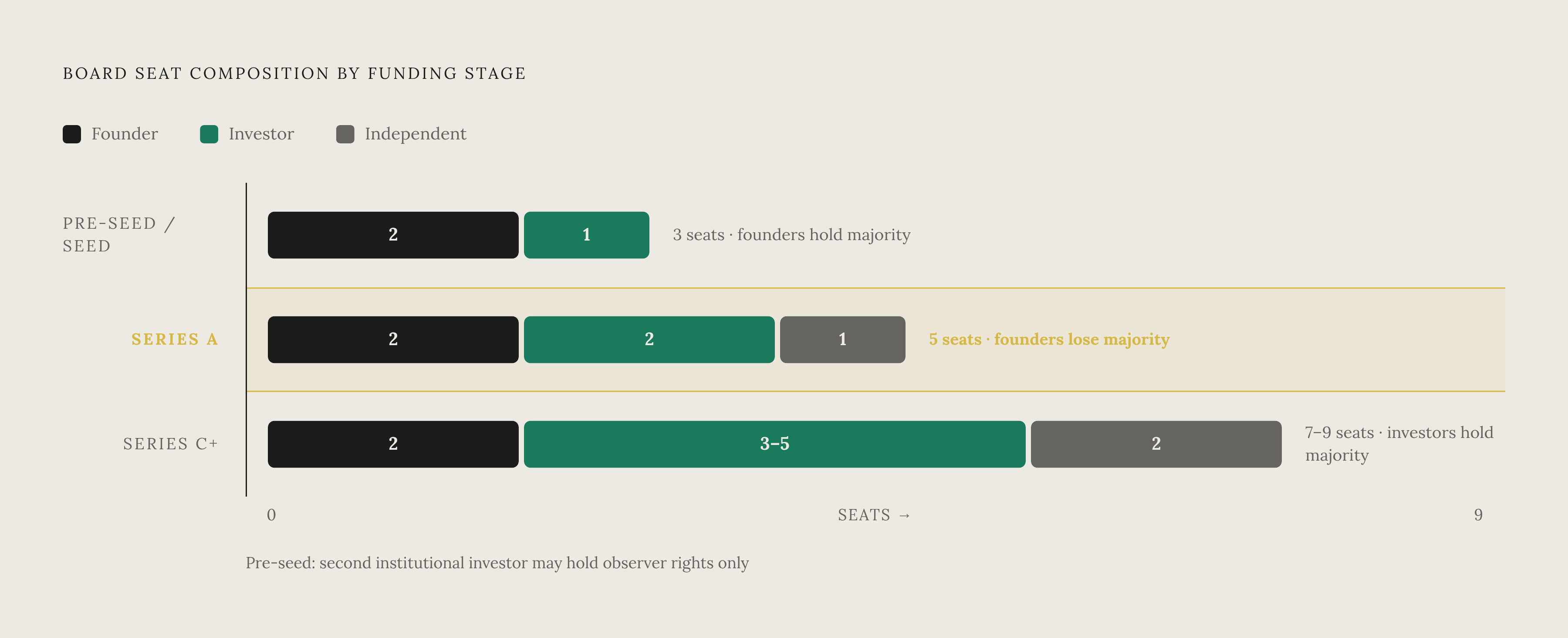
At pre-seed and seed, boards are typically founder-controlled and have one to three members. SAFEs and convertible notes, which are used most often at this stage, rarely come with board rights. A seed investor who asks for a full board seat with such an investment is therefore asking for more than is usual. When a priced seed round does occur, the operative structure is three seats, comprising two founder seats and one preferred investor seat. A second institutional investor usually gets observer rights, which let the investor see what is happening while founders keep control of the vote.
Series A is the major transition because the most common configuration becomes two-two-one. That means two founder seats, two investor seats, and one independent director. When the board grows from three seats to five, founders lose their majority, and the independent becomes the swing vote when founders and investors disagree. Selection of that director can therefore shape contested decisions through Series B and beyond. A less common, founder-favored arrangement has two founder seats, one investor seat, and one independent, but typically requires exceptional founder leverage.
The progression is cumulative because an accepted structure becomes the baseline for the next round. Two investor seats at seed create a problem when the Series A lead requests representation and there is no independent tiebreaker. The later-stage pattern makes that pressure clearer, with Series C+ boards typically expanding to 7–9 seats, including 2 common directors, 3–5 preferred directors, and 2 independent directors. Investors usually gain majority board control by Series B.
What observer rights actually do — and why they are not as harmless as they appear
Observers have no formal vote, but they can influence a decision before anyone votes. They shape board discussions, align with independent directors before meetings, and receive information that informs those conversations. Unlike directors, however, they do not carry the duties of care and loyalty or D&O insurance coverage described for board members. Their confidentiality obligations do not impose the same fiduciary accountability. The central distinction is therefore not simply voting versus watching, but influence with a different legal constraint.
That asymmetry becomes more significant as observer positions accumulate. Multiple observers, each representing a major investor, can form a shadow board whose views founders feel pressure to accommodate before formal escalation. Under Delaware law, founders cannot hold observers to the same duty-of-loyalty standard that applies to directors. Information access is also not absolute, since the company retains the right to exclude observers when attorney-client privilege or trade secrets are at stake.
There is nevertheless a legitimate case for observer participation. Some funds prefer to advise more passively and preserve their ability to join follow-on rounds without the governance friction of a formal seat. Some strategic investors also turn down directorships to limit liability and conflicts. Where an investor uses an observer role as a step toward a later directorship, the initial grant becomes part of a longer governance strategy, making its duration and terms as important as the decision to grant it.
How protective provisions operate as a separate control layer alongside board seats
Board representation and protective provisions operate at different levels of the company. Seats determine who participates in board decisions, while protective provisions can give investors veto rights at the stockholder level. A separate investor approval may still be required even after the directors agree.
A veto over new equity issuances illustrates the distinction. Because a new equity financing requires issuing shares, that right can allow an investor to block a bridge or a new lead without winning a board vote. If the investor also has an observer receiving monthly financials, information access and approval power reinforce each other. The observer can follow the company’s financing needs while the investor retains the ability to stop the transaction. That combination can provide more practical leverage than a directorship without equivalent consent rights.
The scope of those rights determines how far the constraint reaches into daily operations. Provisions that cover executive compensation, annual budgets, or spending thresholds below material levels cause particular friction because they require approval for routine work as well as strategic oversight. Founders should push back on that expansion rather than assume every consent item is inseparable from the investment. Over several rounds, a few Series Seed requirements can add up to a Series C structure in which several preferred classes each have their own thresholds. Winning the seat-count negotiation while accepting that fragmentation does not protect decision-making control.
How founders can negotiate governance terms before signing a term sheet
The first negotiating lever is the market baseline for the company’s stage. A seed investor asking for two investor seats, or a Series A investor seeking representation beyond the two-two-one structure, is requesting more than the usual configuration. Founders can identify that departure directly and discuss what justifies it. Lead status, check size, and ownership thresholds give that conversation a concrete basis. They turn a supposedly standard clause into a proposal whose conditions can be examined.
Investor type provides another lever. Strategics and corporate VCs that are natural candidates for observer status can be offered preferential partnership terms and pro-rata rights in exchange for accepting that role. This approach preserves board seats for financial investors and independents while keeping acquisition optionality open. The observer grant itself remains negotiable, including a limit of one or two observers and termination at the next qualified financing. Founders can also reserve exclusion rights where attorney-client privilege or competitive sensitivity requires them.
Independent director selection deserves the same attention as investor representation. In a two-two-one structure, founders no longer have a voting majority, so the selection process determines who resolves a split. Ceding that process to investor consent can surrender the remaining structural counterweight to investor votes.
The strongest objection to this approach is that founders already spend too much effort counting seats. Governance practitioners warn that founders may fight over three seats versus five while approving consequential actions through thin written consents or overlooking information flow. Seat count is the starting point, while independent selection, observer termination, information access, and consent scope complete the picture.
Preparation must happen before those choices become the inherited terms of another round. As part of that preparation, Metal’s investor search and meeting intelligence can support research into investor fit and anticipated objections, while comparable-deal research addresses the governance pattern itself. The purpose is to understand control creep before signing. Running the full negotiation requires knowing how the particular investor has treated these questions in comparable deals.
Using investor intelligence to prepare for governance negotiations before the first meeting
Knowing the general pattern does not show how a given VC set up boards in its last five comparable deals. That is the practical information gap between understanding governance and negotiating it. VCs arrive with institutional knowledge of market terms and their own prior transactions, while many founders first encounter these decisions in a term sheet. A benchmark for the company’s stage can flag an unusual request, but research into that investor helps explain why it asked and where there may be room to negotiate.
Metal can help through deep investor search, meeting intelligence, and deal signals. Its tools help founders look into investment theses, portfolio fit, and likely objections before calls, so they can prepare for governance talks as part of deciding whether an investor is a fit. For founders seeking to organize that preparation, it is a relevant option because investor research and meeting preparation belong in the same process. Its role is to inform the conversation alongside research establishing how the investor handled comparable governance decisions.
Looking at a firm’s thesis, recent deals, and what is in its portfolio helps founders decide whether to put it on a targeted investor list. Research into its governance track record adds the question that investment fit alone cannot answer. Repeat-founder networks and close relationships can also help founders prepare, though how much they help depends on whom the founder knows. Founders can use these approaches alongside investor intelligence tools.
The result should be a governance conversation that begins before a term sheet arrives. Founders can enter the meeting knowing the expected relationship between lead status, check size, and representation, then investigate how that investor applies it. Fundraising in 2026 is an operational discipline, and governance negotiation is part of that operation. Applying the same research rigor to control terms as to valuation creates a stronger process than treating the term sheet as the start of due diligence.


