Power Law Portfolio Construction and What It Means for Seed Founders
Most venture returns concentrate in a single outlier company, reshaping how founders should pitch.

Founders tend to picture a venture investor as a judge, someone scoring a business plan on its merits and writing a check to the best one. That picture is wrong. A VC is building exposure to a single statistical outlier, and every other company in the portfolio exists mostly as the cost of getting a shot at that one. Horsley Bridge's analysis of fund-level data found the same pattern holding across years of venture performance, with a small fraction of investments generating more than half of total returns.
That concentration is the shape of the market itself, not a sign that managers keep picking wrong. A fund's job is to make sure it owns enough of the one bet that works, not to be right about most of its bets.
What fund math requires from a single investment
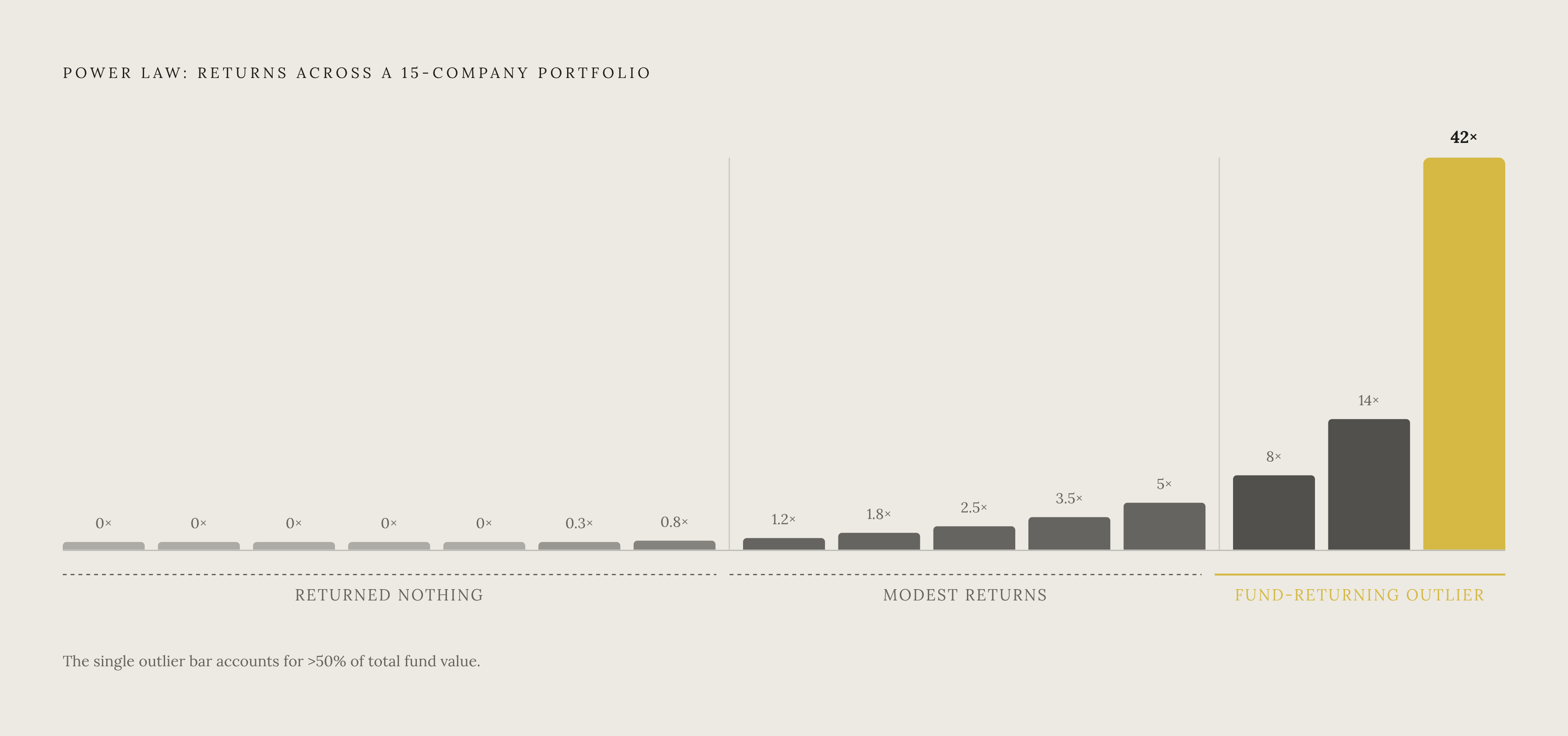
Every VC fund operates inside an obligation chain that starts with its own investors. Limited partners commit capital expecting a return above what they could get in public markets, and general partners only earn meaningful carry once those LP return thresholds are cleared. That structure puts real pressure on a GP to find the outlier rather than settle for a portfolio of solid performers, because solid performers don't clear the bar investors set.
The arithmetic on a typical early-stage portfolio makes the shape clear. A meaningful share of the companies a fund backs will return nothing. And then there's the one company, if the fund is fortunate enough to have backed it, that returns many times its original cost and ends up accounting for more than half of the fund's total value. That single company is doing the work the other dozen were never built to do.
This is why a company can be well-run, profitable, and growing steadily and still not be a fit for venture capital. A "good but not great" business, one with a clear path to moderate success but no plausible route to massive scale, doesn't fit the model no matter how much the general partner personally likes the founder or the product. That's a reflection on what a single check in a venture fund has to be capable of returning, not on the business.
Fund size, portfolio construction, and the ownership floor
The return target set at the fund level dictates decisions founders experience directly: how many companies a fund backs, how much it invests in each, and how much ownership it insists on holding. None of that is arbitrary. All of it is derived math.
A fund has to make enough bets in the first place to have a reasonable statistical chance of catching the one outlier. Portfolio modeling generally supports something in the range of 20 to 30 companies as the number needed to give a power-law distribution a fair chance of producing a fund-returning winner. Fewer than that, and the fund is betting too much on luck; many more, and the fund can't meaningfully support each company or hold enough ownership in any one of them to matter. That second constraint, ownership, is just as load-bearing as portfolio count. A fund has to own a real stake in each company so that if one of them becomes the outlier, that position alone can return the whole fund. When a VC pushes for a certain ownership percentage in a round, that number is a requirement that falls directly out of the fund's math, not a negotiating tactic.
Follow-on strategy works the same way. FB Ventures describes portfolio construction as risk architecture built to manage three separate kinds of concentration: outcome concentration from the power law itself, access concentration over who gets into the rounds everyone wants into, and timing concentration tied to the vintage year a fund is deployed in.
Not every fund sits at the same point on this spectrum. BIP Capital notes that some funds lean hard into the extreme version of power law investing, accepting broad failure across the portfolio in pursuit of the single unicorn, while others prioritize a higher batting average and broader support across their companies. That range matters, and it sets up a direct consequence for founders: the fund sitting across the table has already decided, before the founder walked in, what kind of outcome it needs from this specific check. Everything about how that fund evaluates a pitch flows from that decision.
The information gap this creates for founders who don't know the math
Most founders walk into a pitch meeting answering a question nobody asked them. They prepare to demonstrate that their company is a good business: defensible, growing, run by a capable team. Investors operating under the math described above are asking something much narrower: can this company return the entire fund. Those are not the same question, and a founder who answers the first one well while ignoring the second one is still going to get a pass.
This isn't a matter of the founder's business being weak. One or two companies have to carry the entire fund's return, so an outcome that amounts to steady growth without a credible path to massive scale simply doesn't fit the model, regardless of how well-executed the business is. Investors turning that kind of company down are following the obligations placed on them by their own investors, which leaves no room to fund a company that can't plausibly become the outlier.
The information asymmetry behind the gap between what founders prepare to demonstrate and what investors are actually evaluating is steep. Closing that gap is the single highest-leverage thing a founder preparing to raise can do, and it's the frame the rest of this piece works from.
What "fund-returning potential" requires a pitch to demonstrate
Work backward from the power law and a short list of requirements emerges, each one tied directly to something an investor has to believe before a check can be written.
Market size has to be real, not just large on paper. No amount of excellent execution offsets a market ceiling that caps the company below what the fund needs it to become.
Scale has to look plausible through a specific mechanism, not just as a stated ambition. A deck that asserts big outcomes without explaining the mechanism that produces them is asking the investor to take the hardest part on faith.
The story a founder tells also has to match the stage. At seed, founders are selling potential, the "what could this become" case, and that's appropriate for where the company is. Founders who don't anticipate that shift often find a Series A conversation frustrating because they're still pitching the seed-stage story.
And ownership math has to be visible on both sides of the table. Investors are quietly running the numbers on whether, at the valuation being discussed, they can end up holding enough of the company to make the investment matter if it becomes the outlier. Founders who understand this can price a round and frame dilution in terms that work with the investor's math instead of against it, rather than treating valuation purely as a negotiation over who gets the better deal.
Targeting funds by outlier thesis
The power law doesn't just shape what a founder needs to say. It shapes who the founder should be saying it to, and treating a fundraise as a volume exercise that maximizes the number of meetings usually works against a founder.
Funds differ in where they sit on the power law spectrum, and that difference should guide targeting directly. A company with a genuine shot at massive scale but a long, uncertain path there fits differently with different funds than a company on a faster, more linear growth curve.
Stage and sector focus matter just as much as power law orientation. Most firms want diversification across their own portfolio, so a fund that already has an investment in an adjacent space is more often a reason to expect a pass than a signal of genuine interest.
It's also worth confirming a fund has capital to deploy before investing time in the relationship.
Warm introductions outperform cold outreach by a wide margin in this process, largely because the volume of cold pitches most funds receive makes a cold response rate low under the best circumstances. Building a target list segmented by thesis fit, stage fit, and strength of warm path, then running first meetings in a compressed wave rather than staggered over weeks, creates a kind of competitive dynamic that a slow, one-at-a-time approach can't produce. Common fundraising playbooks recommend keeping that wave under 10 days from first meeting to first meeting across the list.
Framing the pitch narrative around the outlier case
A pitch can be operationally airtight, the team strong, the metrics clean, the plan sound, and still fail to answer the question the investor is actually asking. The narrative has to open with scale before it opens with execution, because investors are filtering first for whether this could plausibly be the outlier and only second for whether this specific team can pull it off.
Market size claims need to hold up under scrutiny. A bottoms-up serviceable market, built from a realistic customer base and realistic pricing, that's still large enough to produce a fund-returning outcome, makes a far stronger case than an inflated headline number ever will.
The mechanism behind winner-takes-most dynamics belongs in the deck explicitly, not as a background assumption. A founder should be able to say precisely what creates the moat, why a network effect compounds as the company grows, and why switching costs rise as more customers come on board, rather than asserting that the company will "win" the category and leaving the reasoning implicit.
Traction at the seed stage should be framed as early evidence of the outlier thesis rather than as proof that the current business is already strong. The question an investor is actually asking is whether the early signal supports the case that this becomes the outlier the fund needs, not whether the business works today. Founders who present traction as validation of the present state of the business, rather than as a signal pointing toward the future scale case, are often leaving the stronger argument on the table.
A milestone-driven plan closes the loop. The fundraising playbook stresses that investors respond well to founders who state clearly how much they're raising and what specific milestones that capital unlocks, framed as the next step toward the scale case. The best use of pitch meeting preparation is testing, meeting by meeting, whether the narrative answers why this becomes the outlier the fund needs.
Running a structured raise process that reflects how investors decide
The same concentration that defines returns inside a VC fund also defines how attention moves across a fundraise. Investor interest, momentum, and competitive pressure don't distribute evenly across the weeks of a raise. They concentrate the same way outcomes concentrate in a portfolio, and that makes process discipline part of the fundraising strategy itself, not an administrative afterthought.
Timing should follow milestones, not a calendar date picked for convenience. The common playbook here calls for timing a raise to a milestone achieved within a 12 to 18 month runway window, with relationship-building among target investors starting 9 to 12 months before the round formally opens. That lead time matters because of what's sometimes called the "lines, not dots" principle: engaging Series A investors well before a seed round closes and learning what milestone bar each fund actually expects means a founder arrives at the next raise already inside that investor's frame of reference.
Compressing first meetings into a tight window, ideally under 10 days, keeps investors evaluating a company in parallel. That parallel structure creates the sense of a competitive process and tends to accelerate decision timelines, while a staggered, drawn-out approach lets momentum drain away between meetings. Pipeline discipline matters just as much once interest starts to firm up: expect to pitch many investors for each term sheet that comes in, and once a term sheet does arrive, inform the rest of the active pipeline immediately rather than letting the process run quietly in parallel. That stage is also not the time to bring in new investors who can't move at the pace the round now requires.
Instrument choice should match where the company actually is. Priced rounds fit better at Series A and beyond, or earlier when a clear lead investor is already in place and the round is large enough to justify the legal cost of running a priced process.
For founders coming out of an accelerator, the days right after Demo Day carry most of the weight of the entire raise. The founder of one well-known accelerator company put the goal in the simplest possible terms: get the money needed at a reasonable price and get back to building.
None of this requires an unusual network or a lucky break. It requires understanding that a fund is built around a single outlier, that every term and question a founder encounters traces back to that requirement, and that a raise run with that logic in mind looks structurally different from one run without it. Founders who understand the power law are better prepared to answer hard questions in the room and run a different kind of fundraise, one built around how investors actually decide.

