Evergreen Funds vs. Traditional VC Funds for Seed Founders
Evergreen funds eliminate the forced exit pressure that closes traditional funds' ten-year windows.

How a traditional closed-end VC fund's structure forces outcomes on investors
A traditional VC fund raises a fixed pool of money and gives itself a fixed life to invest it: usually ten years, with two optional one-year extensions tacked on. The industry calls this the "10+2" structure. That decade splits into two phases. An investment period, typically the first five years, is when the fund writes checks into new companies. A harvest period, years five through ten, is when the job shifts to producing exits and returning cash.
The fund charges a management fee, commonly 2% of committed capital during the investment period, to cover salaries and operations. Carried interest, the GP's cut of the profits, only pays out once capital actually gets returned to the limited partners who backed the fund. Once a portfolio company exits, the proceeds go straight back to those LPs. They don't get reinvested into new deals. That single mechanic is the whole ballgame: a closed-end fund cannot recycle its winners into fresh bets the way an evergreen structure can.
That's where the tension starts. A general partner has to generate liquidity within the fund's contracted life, whether or not the company sitting in the portfolio is at peak value or three years from it. Funds shift toward older, more mature startups as their remaining life shrinks, a structural bias that quietly starves the earliest-stage companies of capital right when a fund is running out of runway. None of this makes closed-end funds badly run. It means the calendar, not the company's actual readiness, sets the pace, and founders who miss that distinction end up negotiating with a clock instead of a person.
What the exit clock does to founders inside a traditional fund portfolio
Somewhere around year seven of a fund's life, LPs start asking for concrete signs of exits. That pressure doesn't arrive all at once. It builds every quarter, and by year eight or nine it's the dominant conversation between GP and LP. The median VC-backed exit now takes nine years, and many unicorns have been held nine years or longer, according to the Venture Studio Forum newsletter.
Liquidity has gone negative in a way that makes this pressure concrete rather than theoretical. PitchBook-NVCA data cited in that same newsletter shows LP net cash flows running a deficit of $169 billion since 2022, and PitchBook counts more than 57,000 startups currently stuck inside VC portfolios with nowhere to go.
Run the numbers on your own raise. If you take money from a fund sitting in year four or five of its life, the "10-year fund" framing is mostly cosmetic: you may have three to five years before that investor needs a liquidity event, not the decade the fund's name implies. Asking a VC directly where they sit in their fund's cycle is basic diligence, and a fund early in its life offers a genuinely different kind of alignment than one heading into harvest. Some critics call the entire ten-year closed-end template a relic from 1959, ill-suited to a market where hundreds of billions in value now sit locked across tens of thousands of private companies waiting on exits that aren't coming on schedule. That argument is pointed, and the math behind it backs it up more than it undercuts it.
The structural features that make evergreen funds mechanically different
An evergreen fund, sometimes called open-end, has no fixed termination date and no scheduled return of capital to LPs. When a portfolio company exits, the proceeds don't get distributed out the door. They get reinvested into new deals. The fund compounds instead of winding down, and that one difference reshapes almost everything downstream of it.
Two flavors exist. Some evergreen funds keep a slice of liquid assets on hand, often targeting around 15% of the portfolio, specifically to fund periodic investor redemptions. Others stay fully invested in private assets, trading away liquidity for maximum compounding. New investors typically buy in at net asset value, and existing investors can withdraw at set intervals, subject to how much liquidity the fund actually has on hand at that moment. This "semi-liquid" model is becoming a bigger part of the venture landscape.
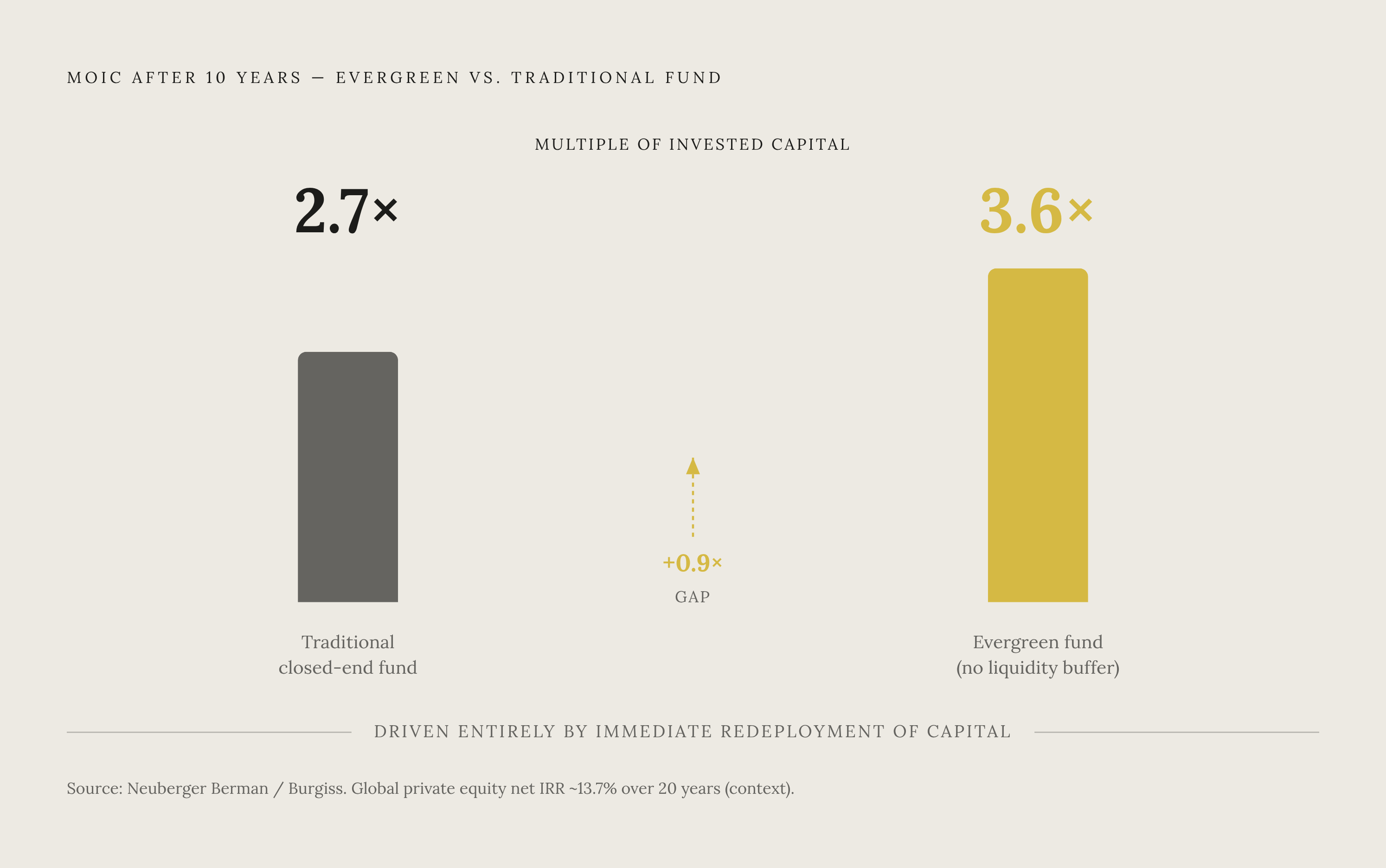
The patience argument behind evergreen structures has real backing. Studies cited in RedAlpine's research show many category-leading companies don't peak in value until 12 to 15 years after founding, well past what a closed-end fund's harvest window can absorb. Neuberger Berman ran the numbers on what that patience is worth: over a theoretical ten-year period, assuming identical underlying returns, Burgiss puts global private equity net IRR at roughly 13.7% over 20 years, an evergreen fund with no liquidity buffer produced a 3.6x MOIC, against 2.7x for a comparable series of traditional fund commitments. The gap comes from one thing: immediate redeployment of capital that would otherwise sit distributed and idle, waiting for the next fund to call it.
What investors' choices to adopt evergreen structures reveal
Sequoia Capital made the loudest move in the category. In 2021, the firm dissolved its traditional fund model entirely and replaced it with The Sequoia Fund, an open-ended vehicle described at the time as the single biggest structural change in venture capital's history. That fund has grown to $20 billion in assets as of 2024, and its structure lets Sequoia hold positions in public companies like Airbnb, DoorDash, and Nubank indefinitely, with no forced selling on anyone's calendar. The structure also removes pressure to exit positions simply because a fund's clock has run out.
Andreessen Horowitz followed similar logic for a different purpose. TechCrunch reported that the firm filed with the SEC in June 2023 to launch the a16z Perennial Venture Capital Fund, an evergreen wealth vehicle built for high-net-worth individuals. It's open-ended and perpetual, and as a side effect it lets the firm hang onto public company positions rather than distribute them to LPs on a fixed schedule.
Corporate venture arms have run this playbook for a lot longer, just with less fanfare. Swisscom Ventures has operated an evergreen vehicle since 2007, racking up more than 80 tech investments and nearly 40 profitable exits, a track record most evergreen newcomers can't match. Novartis Venture Fund runs roughly $750 million in assets across more than 40 active portfolio companies, using a balance-sheet evergreen structure built for multi-decade life-science bets where a ten-year clock would be almost meaningless.
The category kept expanding through 2025. StepStone Group, which oversees more than $675 billion in assets under advisement and management, launched the StepStone Private Venture and Growth Fund as an evergreen closed-end vehicle targeting the "innovation economy" from seed through growth equity, focused on companies already generating at least $10 million in annual revenue. Smaller players are in the mix too: Fairway Capital Management, an Adams Street spinout founded in 2020, raised two traditional VC funds of funds totaling $52 million in commitments before launching an evergreen fund of funds at the end of 2021, which held approximately $26.3 million in net assets as of March 2026.
Lining those examples up shows no single motivation explains all of them. Sequoia and a16z want to hold public winners longer. Swisscom and Novartis want strategic patience that matches R&D timelines measured in decades. Fairway is using the structure to open access for smaller investors who couldn't write a traditional fund-of-funds check. Same wrapper, different reasons, and a founder evaluating any one of these needs to ask which reason actually applies to the check in front of them.
Why evergreen structures are not automatically better for seed founders
Treating "evergreen" as shorthand for "better aligned" is a mistake, and the performance data makes the case. Venture capital has the widest performance spread of any private market asset class. PitchBook's Q4 2025 Global Fund Performance report shows that for 2005 to 2020 vintages, the gap between top-quartile and bottom-quartile fund IRR runs 16.6 percentage points, wider than the spread in PE growth. Manager selection matters far more than wrapper type, and a large evergreen vehicle doesn't automatically buy access to the managers producing top-quartile returns.
Kevin Callahan of Fairway Capital put the underlying constraint bluntly in PitchBook's reporting: it's very difficult, maybe impossible, to keep shoving more capital into an asset class that's fundamentally capacity-constrained and still deliver the returns investors expect. Fund-of-funds evergreen structures are one answer to that problem, but a seed founder can't just pick that answer off a shelf when evaluating a term sheet.
Bigger evergreen managers face a related allocation problem. Deal flow gets split across institutional funds, separately managed accounts, and the evergreen vehicle itself, and the best deals don't automatically land in the evergreen product just because it exists. Evergreen structures are also genuinely hard for small and mid-sized managers to run well: the model is mostly adopted by large, global, multi-stage firms because managing redemptions, NAV calculations, and cash flow adds real operational complexity. A boutique GP running an evergreen seed fund may spend time on plumbing that a traditional seed fund GP never has to think about.
Meeting redemption requests without gutting the portfolio is a constant balancing act, and it gets a lot harder during a downturn, exactly when a founder most needs an investor's attention rather than an investor's cash management headache. Fees deserve scrutiny too. Carried interest doesn't map onto an evergreen fund's mechanics the way it does in a closed-end structure, so founders should ask how their prospective investor gets paid and when. A confusing valuation-based fee arrangement can create its own perverse incentives, just quieter ones than a hard exit deadline. With no termination date, the pressure comes from LP redemption requests instead of a fund's expiration, and that pressure is harder for an outsider to see coming.
The four questions seed founders should ask any prospective investor about fund structure
Fund structure is a live question to raise in the room, not something to research once during diligence and file away. The same fund brand can mean something completely different depending on vintage year, where the fund sits in its cycle right now, and how the GP handles liquidity day to day.
Where are you in your fund cycle? A fund in years one through three has close to a decade of runway ahead. A fund in years four through six may need to start generating exits within three to five years. Ask directly, then map the answer against your own company's realistic growth timeline.
What happens to an investment if the company isn't ready to exit on the fund's schedule? Traditional funds face real structural pressure to force a sale or accept a secondary transaction once the clock runs low. Evergreen funds can hold longer, but whether they actually will depends on that fund's specific redemption dynamics. Ask for real examples: has this GP held a portfolio company past its expected timeline before, and what did that look like in practice?
How does your fund structure affect follow-on capital? Traditional funds reserve capital for follow-on rounds mostly during the investment period, and late in a fund's life those reserves are often thin or locked up defending existing winners. Evergreen funds can recycle exit proceeds into follow-on checks, but whether they'll actually put money into your next round depends on portfolio construction policy, not just whether the cash exists.
How are you compensated, and when? Carried interest tied to realized returns pushes traditional fund GPs toward exits. Evergreen fee structures vary a lot from fund to fund and need to be understood before a term sheet gets signed. A GP whose carry is tied to NAV appreciation behaves differently than one whose carry only pays out on cash distributions, and founders should ask which one they're actually dealing with.
None of this settles which is better, evergreen or closed-end. It confirms, before signing anything, that the structural incentives on the other side of the table point in the same direction the company is headed.
Using fund structure as an investor targeting filter, not just a diligence item
Founders who build target lists on sector fit and check size alone are optimizing for the wrong signal. An investor can be perfect on paper, right sector, right stage, right check size, and still be badly misaligned on timeline simply because their fund happens to be sitting in year seven.
Some practical logic follows from that. Founders working on long product timelines or in capital-intensive categories like deep tech or biotech get the most benefit from evergreen alignment, since those businesses often need more than a decade to reach real scale. Founders with a genuinely fast, clean path toward acquisition may find a traditional fund's incentives entirely adequate: the exit clock only becomes a problem once your timeline runs past it. Building a long list of prospective investors after a pitch event isn't enough on its own. That list needs filtering by fund vintage, fund type, and fund position.
Investors know what year of their fund they're operating in. The gap in founders' knowledge occurs because they usually don't ask, and closing it is part of what separates a disciplined raise from one that reacts to whatever term sheet appears first. Fund vintage, fund type, typical check size, and portfolio construction patterns are the same categories of intelligence institutional allocators use to evaluate GPs before committing capital, and that same caliber of information is increasingly available to founders building their own target lists.
Fund structure works as a targeting variable that shapes who goes on the list in the first place, as negotiating context once term sheets land on the table, and as a decent predictor of how the relationship holds up three years into the company's life. Founders who treat it that way aren't just protecting themselves against a bad outcome. They're running a structurally sharper raise from the very first conversation.