How New Fund Raises by GPs Change Their Investment Behavior
Longer fundraising cycles and fresh fund closes reshape which GPs will actually write checks.

How the current fundraising environment is reshaping which GPs are in-market
Fundraising doesn't just fund a GP. It changes how that GP behaves, on a timeline a founder can actually track. Check size, stage appetite, risk tolerance, deployment speed: all of it shifts the moment a new fund closes, and shifts again as that fund ages. Most founders skip this analysis entirely and treat a target list like a static directory: find a firm that claims to invest in your stage, get an intro, pitch. That approach misses the one variable that predicts almost everything else. It is where the GP actually sits in their own fund's life cycle.
Funds are taking longer to close than they used to, and the average fund now spends close to 20 months actively fundraising, nearly double the pre-pandemic pace. A lot of GPs sit stuck in a holding pattern between vintages, unable to reset their deployment behavior until the new capital actually lands. First-time managers have it worse. Median time to close a debut fund passed 18 months in 2025, up from 14 months in 2023. A growing pool of emerging managers stand at the starting line for a year and a half or longer while the clock on their thesis and their LP relationships keeps running with nothing deployed to show for it.
Capital keeps flowing toward names LPs already know. Roughly 70% of LP commitments go to existing GP relationships, so the managers who close funds quickly tend to be the same managers who closed the last one, and the one before that. Only 327 domestic private equity funds reached final close in 2024, down sharply from 1,089 in 2022. Pick a side on what that means: the pool of GPs actively deploying fresh capital right now is much smaller than the length of a typical target list would suggest, and the established names and the emerging ones behave in genuinely different ways once they close. Treating them as interchangeable rows on a spreadsheet is the mistake.
The deployment clock: how a new fund close immediately reshapes a GP's urgency and pace
The day a fund closes, the clock resets to zero, and GPs feel that immediately. LPs expect to see capital move, and a GP who sits on dry powder for a year without a deal starts to look like a GP who can't source or can't decide. That reputational risk shapes behavior long before it appears in any official communication to founders.
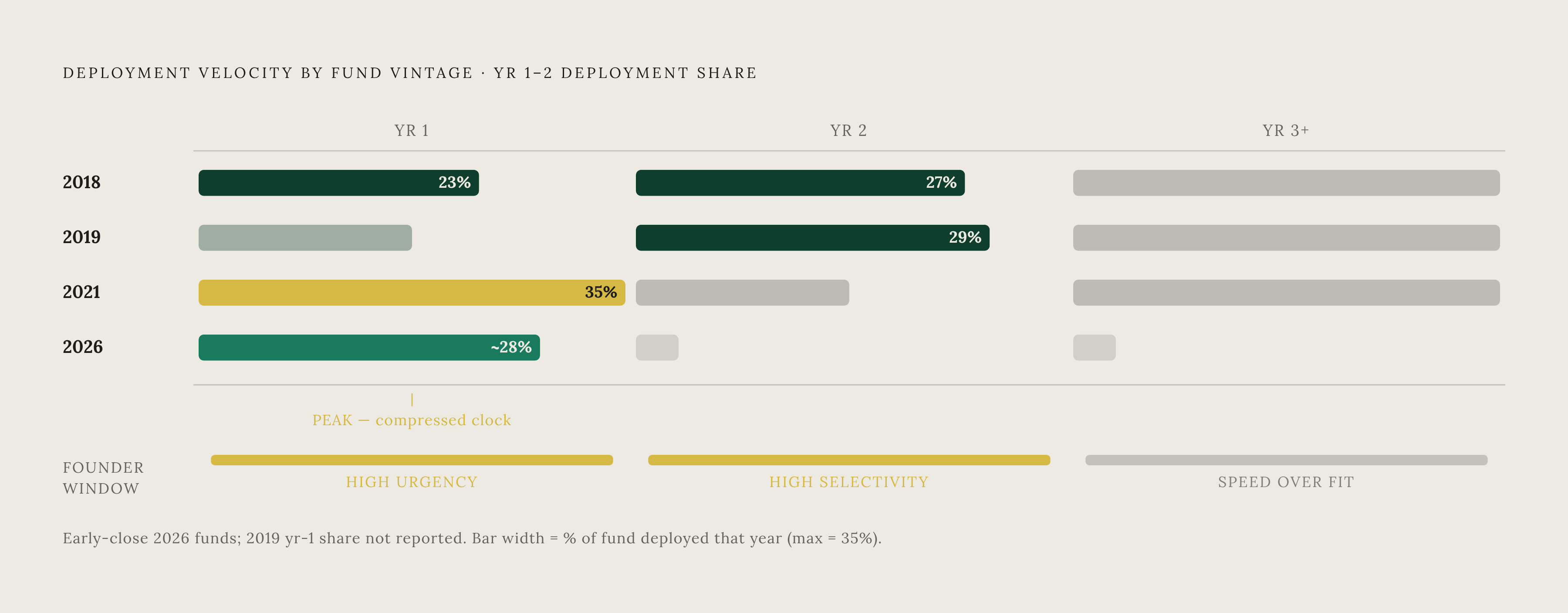
Deployment data across roughly 1,800 funds shows the 2018 vintage put 23% of committed capital to work in year one and 27% in year two, with 2019 tracking similarly in year two at 29%. Year two, historically, is when velocity peaks, not year one. Recent vintages compress that timeline hard: the 2021 vintage deployed 35% by the end of year one, and funds closing in the first quarter of 2026 have already put roughly 28% of committed capital to work. The exact pace moves with the market, but the pressure to show early activity stays constant.
Funds approaching the end of their commitment period, typically in the later years of the deployment window, start optimizing for speed because runway to deploy is running out. A freshly closed fund carries none of that pressure and can afford to be choosier. So a founder pitching a GP in year one or two of a new fund catches that GP at the exact moment when urgency to deploy and willingness to actually vet a deal both happen to be high, and that window closes. It doesn't stay open, and nothing about a firm's brand or reputation slows the closing.
How fund size changes what a GP can and will write a check for
Fund size is the constraint that decides which founders a given GP can realistically write a check to, regardless of what the firm's website or pitch deck claims about stage focus.
Run the math on a fund aiming for 20 portfolio companies. A naive average suggests checks far larger than the portfolio math actually supports. But management fees, typically 2% annually, eat into the pool over the fund's life, and if the GP reserves roughly half of what remains for follow-on rounds, the initial check that actually gets written lands closer to a much smaller sum than the fund's headline size implies. A bigger fund doesn't automatically mean more access at seed. Often it means the opposite, because the GP's own portfolio construction math forces the firm further upmarket regardless of what the website says.
A 1:1 reserve ratio, meaning half of invested capital gets held back for follow-ons, signals a GP built to defend ownership through Series A and B, and a founder pitching that GP at seed needs to understand reserve strategy splits into distinct postures before a pitch. A 1:1 reserve ratio, meaning half of invested capital gets held back for follow-ons, signals a GP built to defend ownership through Series A and B, and a founder pitching that GP at seed needs to understand the firm is underwriting for its own follow-on capacity as much as for the deal in front of them. A 2:1 ratio shifts the posture: less capital held in reserve means more scrutiny goes into the seed decision itself, since there's less dry powder available to bail out a mediocre pick later. Reserves don't only fund winners, either. In a slow exit environment, GPs sometimes redirect reserve capital toward bridge financing for portfolio companies in distress, which quietly competes with the capital that would otherwise back new deals.
Stage drift and thesis migration: what happens when a GP grows (or shrinks) their fund
GPs almost never announce that they've moved upmarket. The portfolio says it before the GP does. A larger fund produces larger checks, and larger checks force a later entry point, regardless of what the firm's stated mandate still claims on its site.
The reverse happens too, and it's the pattern most founders miss because they're only watching firms trending up. A GP who raises a smaller fund after a rough fundraising cycle often gets pushed back downstage, chasing deals small enough that the check size stays competitive. That's an opening for a founder paying attention: a GP's recent fundraising history can tell you that firm only plays at seed again because its current fund needs it there, not because the mandate changed out of conviction.
Thesis migration runs on the same logic. Plenty of GPs raised broad "frontier tech" mandates in 2020 and 2021 and are now narrowing hard into specific verticals under pressure from LPs who want a cleaner story to bring to their own committees. The mandate live today can be far tighter than the one that produced the firm's most visible, most cited investments, and pitching against the old mandate instead of the current one wastes a meeting.
Risk appetite and GP commitment: behavioral signals that new fund dynamics send to founders
GP commitment, the share of a GP's own money sitting in the fund alongside LP capital, works as a behavioral signal, not just a line item buried in the fund's governing agreement. A Preqin analysis found private equity funds where the GP committed 3% or more of fund size outperformed funds with sub-1% commitments by 280 basis points in net IRR over a ten-year horizon. The mechanism is behavioral: a GP with real money on the line gets more careful about entry valuations and more hands-on once the check clears.
Commitment norms have moved. GP commitment levels have moved meaningfully upward from where they stood a decade ago. Today's GPs carry more personal exposure to their own decisions than the prior generation did. That cuts both ways. It buys more discipline on the way in, but it also buys more hesitation to swing on anything unproven, since a bad bet now costs the GP personally in a way it didn't a decade ago.
When fundraising gets hard, DPI (distributed-to-paid-in capital) becomes the pressure point that actually moves behavior. LPs want to see cash come back before committing to the next fund, so a GP under fundraising strain starts optimizing for exits instead of for building. Hold periods compress, and attention shifts from patient portfolio construction toward whatever gets a deal to a liquidity event fastest, which is not always the decision that serves the founder's long-term interest.
The bifurcated market founders are navigating in 2026
The 2026 market splits, hard, between a narrow band of abundance at the very top and scarcity everywhere below it. That split, not the aggregate headline number, is the fact a founder needs to plan around.
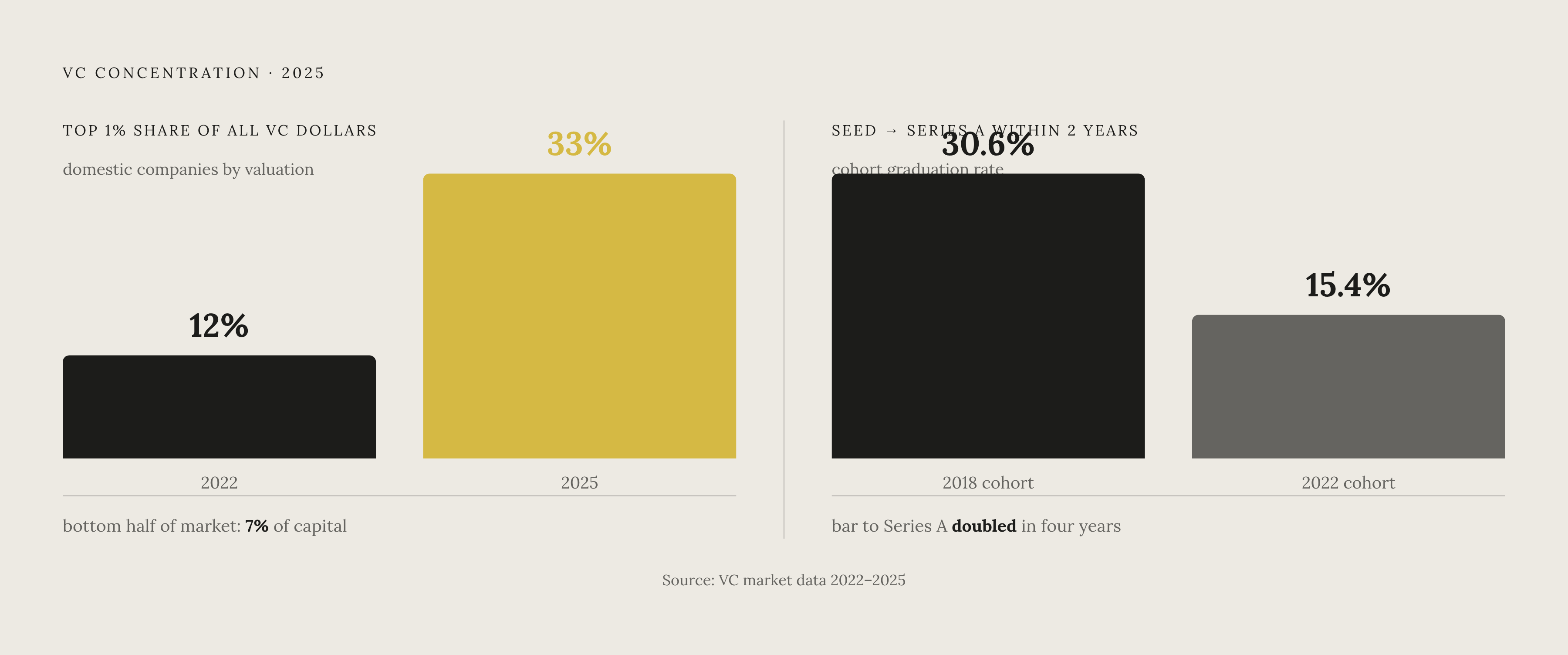
SVB data shows the top 1% of domestic companies by valuation captured 33% of all VC dollars in 2025, up from just 12% in 2022, while just 7% of capital reached the bottom half of the market. Global venture investment hit $300 billion across 6,000 startups in the first quarter of 2026, up more than 150% both quarter-over-quarter and year-over-year, but that number does a lot of work to hide the real story. OpenAI's $122 billion close and Anthropic's $30 billion round alone distort the aggregate badly enough that the median deal looks nothing like the total suggests, so any founder benchmarking a raise against that headline is benchmarking against noise.
The downstream effect is most visible in graduation rates. The 2022 seed cohort produced only a 15.4% graduation rate to Series A within two years, compared to 30.6% for the 2018 cohort. That bar for follow-on capital roughly doubled in difficulty in four years, and it stands as the clearest proof available that GP conservatism is a measurable shift in underwriting standards. It's a measurable shift in underwriting standards, and it applies whether or not a given GP says so out loud.
Reading where a specific GP is in their fund cycle before you pitch
None of this sits hidden. The information asymmetry here is entirely self-inflicted, sitting in public filings and press releases that almost nobody reads before a first meeting.
SEC Form D filings show exactly when a fund registered, what the target raise was, and the date of first sale. A fund registered six to eighteen months ago is very likely still in early, high-velocity deployment. Portfolio announcement cadence tells a similar story from a different angle: a GP announcing new deals frequently is actively deploying, while a GP gone quiet may be mid-raise, waiting on an LP close, or holding reserves tight for an existing book that needs support. LP updates and press releases almost always cover fund closes directly, and that announcement date is the actual reset point for the deployment clock, not whenever the firm starts talking about the fund publicly.
Comparing a GP's new fund size against the prior fund adds another layer. A jump in size points toward upmarket drift. A smaller fund than last time suggests either a deliberate, disciplined narrowing of mandate or a fundraise that didn't go the way the GP hoped, and those two scenarios call for different pitches. Watch check size against stated fund size, too: a GP writing checks that look unusually large for a fund of its size is probably deploying out of reserves rather than fresh capital, a meaningfully different posture heading into a first meeting.
Generic sector-fit targeting doesn't move the needle the way it used to. Knowing a GP invests in your sector is table stakes, nothing more. What matters is whether that GP's current fund construction, the one live right now, can actually accommodate your round size and your stage. According to Campbell Lutyens, GP stakes and GP M&A transactions rose 40% year-on-year in 2025, reaching record volume, and a GP who's sold a stake now answers to a strategic partner who may be shaping deal selection in ways that never appear anywhere on the firm's website.
Timing your raise around GP deployment windows rather than against them
The single most useful thing a founder can do with all of this is sequence outreach by fund age instead of firm reputation. A GP that closed a fund within roughly the past year or so is in an early, high-velocity phase of the fund cycle, with LP pressure to deploy still fresh, a thesis newly articulated that hasn't drifted yet, and check sizes calibrated to a fund that just got built rather than one four years deep into its commitments.
That's a pitch aligned with a structural reality sitting in public filings for anyone willing to look before the meeting instead of during it. A GP in year one or two of a new fund is under real pressure to move and still has room to be selective about who gets backed, which is about as good a combination as a founder is going to find anywhere in this market. Later in that same fund's life, urgency curdles into a scramble to hit deployment deadlines, and the calculus a GP applies to a new deal changes completely, regardless of what the pitch deck in front of them still says about stage and thesis.

