Sector Concentration Limits and What They Mean for Your Pitch
Funds hitting sector limits are passing on strong pitches for reasons founders never hear.

Founders who understand that sector concentration limits (written into LPAs or enforced by a fund's existing portfolio exposure) are a structural reason investors pass on otherwise strong pitches can target investors with genuine capacity and tailor their narrative accordingly. Sector Concentration Limits and What They Mean for Your Pitch.
Sector concentration limits and their origins
Concentration limits in venture take two forms, and founders tend to conflate them because both produce the same result: a no. The first is written down. LPA-level limits get negotiated at fund formation between the general partner and the limited partners who supply the capital, and they're binding. They typically cap how much of the fund can go into a single company, and separately, how much can go into a single sector or geography. The second form never appears in any document. A fund's existing portfolio can simply fill up on a sector through the ordinary course of deploying capital, even with no explicit rule stopping further investment there. Call it the full bucket effect: the fund still likes the space, still wants to see the deal flow, but has already made its bets and has nowhere left to put fresh capital.
LPs push for these guardrails because they want assurance the fund isn't secretly a single-sector bet dressed up as a diversified vehicle, and in some jurisdictions there's a regulatory dimension to it as well. Within that, founders should separate two distinct mechanics. Per-company limits protect against a fund over-indexing on any one outcome, win or lose. Per-sector limits cap how much of the whole portfolio sits in one vertical, and this is the constraint that shapes far more pitch outcomes than founders realize, mostly because nobody says it out loud.
None of this makes concentrated portfolios a red flag on the GP's part. A fund that's heavily weighted toward one sector is often just a fund with real conviction and real domain depth, built by investors who know the space cold. The fund believes in the sector, and that's simply not the trouble for a founder. It's that the fund may have already spent that belief on someone else's cap table. A fund's stated focus and its actual remaining capacity are two separate things, and founders routinely treat them as one.
The current funding environment and the practical edge of concentration limits
The macro numbers, at first glance, tell a story of abundance. Global venture funding rebounded 47% in 2025 to $469 billion, according to CB Insights, with Q4 2025 alone bringing in $152 billion, the strongest quarter since Q1 2022. On paper, this looks like the best fundraising environment in years.
It isn't broad. OpenAI's $122 billion raise in Q1 2026 accounted for roughly 43% of CB Insights' entire quarterly total on its own, and Anthropic added another $30 billion in the same period AI Startup Trends 2026: 6 Funding Shifts for Founders. PitchBook found that if you strip out the five largest deals of the quarter, total deal value falls by 73.2%. A record quarter, built almost entirely on five companies. CB Insights' full-year 2025 figures tell the same story from a different angle: deal count actually fell 17% to 29,501, even as mega-rounds jumped 77% to 738 and captured 65% of all venture funding AI Startup Trends 2026: 6 Funding Shifts for Founders. Fewer deals, more money, concentrated in fewer hands.
AI is the engine behind all of it. That climb, inside a single year, is not a gradual drift; it's a reallocation happening in real time.
Put those two facts together and the mechanism becomes clear. Funds have raised enormous sums specifically to chase AI, and that same rush is pushing many of them toward, or straight past, their own sector concentration ceilings in that vertical. The bucket is filling faster than at any point the industry has seen. As JPMorgan Chase's Ginger Chambless put it in July 2026, "this level of concentration is without precedent in modern venture history," and that claim should be taken at face value rather than filed under cyclical noise. This is a structural condition, not a phase that resolves itself next quarter. Q1 2026 global VC hit $330.9B across 8,464 deals per KPMG, more than doubling Q4 2025's $128.6B. Fund-level concentration mirrors deal-level concentration: 73% of all LP capital raised in Q1 2026 went to just five venture firms, and a16z's $15B January 2026 fundraise alone represented more than 18% of all 2025 U.S. VC commitments per NVCA 2026 Yearbook data.
The two-tier reality concentration creates for founders pitching right now
That structural condition splits founders into two camps, and each one experiences concentration limits in an almost opposite way. AI founders are pitching into more available capital than at any recent point in memory, but the qualifying bar has moved sharply upward. Investors now open meetings with questions about data moat, inference costs, and whether the product survives the moment a foundation model ships the same feature natively. "Own the model, not the wrapper" has become the operative filter for 2025 and 2026 AI Startup Trends 2026: 6 Funding Shifts for Founders.
Non-AI founders face the inverse difficulty. They're competing for a shrinking share of available capital, because funds that have hit their AI concentration ceiling are often simultaneously constrained in adjacent categories, having reallocated internal bandwidth and dry powder toward the sector everyone's chasing VC Funding Q1 2026: Record $330.9B and 80% AI. Wellington Management's 2026 VC outlook stated: "this hyperfocus on AI has had widespread impacts on fundraising for other sectors".
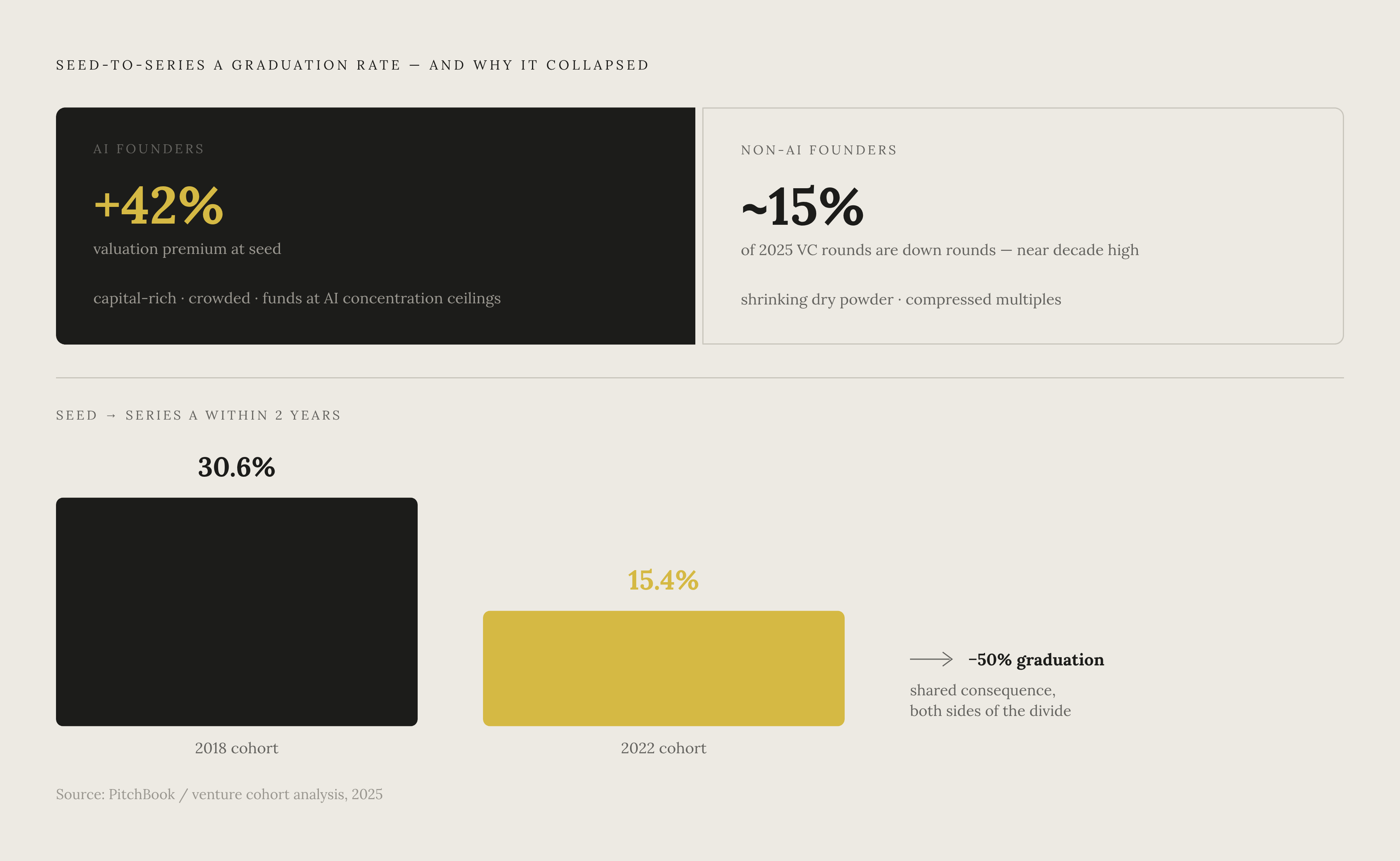
The valuation data makes the split concrete. Seed-stage AI companies are closing at a 42% valuation premium over non-AI peers, while roughly 15% of all VC rounds in 2025 were down rounds, near the decade high set the year before VC Funding Q1 2026: Record $330.9B and 80% AI. Downstream, the squeeze reduces graduation rates: only 15.4% of seed-stage companies from the 2022 cohort managed to raise a Series A within two years, the lowest rate on record, compared to 30.6% for the 2018 cohort. Fewer companies are making it from one stage to the next, and concentration is a meaningful part of why.
A fund's concentration ceiling in a given sector is almost never disclosed to the founder being passed on. Founders read the pass as a verdict on their product, when it's frequently a portfolio construction decision that has nothing to do with the pitch's quality. Even AI founders riding the premium shouldn't assume the ground is stable VC Funding Q1 2026: Record $330.9B and 80% AI. International Banker flagged that a repricing of AI's elevated valuations "could then cascade through the capital stack, hitting earlier-stage rounds benchmarked against those valuations". Concentration, in other words, creates a kind of fragility that can flip investor appetite fast, in either sector.
Reading whether a fund has capacity in your sector before you pitch
Given all that, the practical question for a founder becomes: how do you know, before you send the deck, whether a given fund actually has room? Three signals can be checked, and none of them require an insider relationship to find.
Portfolio density comes first. Count how many companies in the founder's exact vertical already sit in the fund's portfolio relative to its total size. A fund with a dozen fintech bets inside a thirty-company portfolio is very likely near its informal ceiling, whatever its website says about loving fintech. Recency of deployment matters just as much. A check written in that sector within the past six months suggests an active, funded thesis; a gap of two years or more often means the bucket is full, or that the fund's attention has simply moved on. Third, and most underused: public thesis documents. Some funds state sector caps directly and openly. Others reveal the same information indirectly, through GP interviews, LP letters, or conference commentary, and platforms like Metal, an AI-driven fundraising tool that parses investor thesis signals and portfolio composition to surface targeting intelligence before a founder sends a single email, exist precisely to make these primary sources actionable rather than overlooked.
Fund size changes this calculation considerably. That's a structural advantage smaller funds hold, not a consolation prize. Blair Cohen of GoalVest Venture Capital made the underlying dynamic explicit in January 2026: as fund sizes grow, "strategies tend to shift from finding a small number of exceptional outcomes to deploying across hundreds of companies, which looks much more like beta exposure than alpha generation". Large-fund concentration limits and small-fund concentration limits are not operating on the same scale, and founders should stop treating them as if they are.
There's a rough math to keep in mind too. Knowing that number lets a founder estimate, with some precision, how many same-sector bets a given fund can realistically make before its informal ceiling kicks in. Emerging manager dynamics matter here: funds under roughly $250M face frozen LP commitment pipelines, but a $30M fund can spend a week on diligence on a $2M seed round in a way a $500M fund cannot economically justify, giving these smaller funds genuine capacity at Seed, according to VC Funding Q1 2026: Record $330.9B and 80% AI.
What concentration-aware investor targeting looks like in practice
Targeting is the step that actually determines outcomes here, more than the pitch itself. Send a genuinely strong deck to a fund with a full bucket and the result looks identical to a merit-based rejection, when it's really a portfolio decision made before the meeting ever started.
A concentration-aware list looks different from a generic one. It favors funds actively deploying in adjacent verticals but not yet saturated in the founder's exact sector, since that combination signals an open thesis and a GP who understands the space without already being overexposed to it. It also favors funds whose most recent sector investment landed at a different stage or with a meaningfully different business model, since that overlap concern mostly evaporates. And it favors emerging managers early enough in building out their sector exposure that one more company adds to their thesis credibility rather than their concentration risk.
Cold outreach itself has changed shape. Both sides now use AI to filter it, which means generic emails get discarded faster than ever, and the floor for a response has risen VC Funding Q1 2026: Record $330.9B and 80% AI. The message needs to show the founder understands what the fund's current sector concentration looks like, name its most recent adjacent investment, and state a clear stage and check-size fit. Research that once ate more than 40 hours per raise now takes a fraction of that time; founders still building lists by hand are effectively paying a tax on their own process. The discipline isn't in how fast that information gets gathered, it's in how carefully it gets applied.
Several tools now exist across this investor intelligence stack. OpenVC handles discovery and outreach. Decile Hub and V7 Go extract information from documents and automate parts of the deal-flow workflow. Quill, formerly Flowlie, runs a broader autonomous back office spanning finance, HR, compliance, and fundraising. PitchProtocol routes applications across funds in a structured way, and a newer class of AI-native fundraising platforms folds targeting, pipeline management, and outreach into one system. None of it belongs in the pitch itself. The advantage lives in the operational discipline applied before the first call ever happens.
Adapting the pitch narrative when sector concentration is a likely objection
Once a founder is confident a fund has capacity, the pitch itself still has to answer a question that's rarely spoken aloud: why does this company reduce the fund's concentration risk in the sector rather than adding to it?
For a fund with heavy existing exposure to the space, the pitch should lead with differentiation from that fund's own portfolio companies specifically, not with generic market positioning. It helps to frame the new investment as completing a thesis rather than doubling down on one. A fund that's already backed infrastructure plays, for instance, can view an application-layer company as filling out the thesis rather than piling onto it.
AI founders face a specific version of this. Investors are opening meetings with questions about data moat, inference costs, and whether the product survives once a foundation model absorbs the feature. The decks that have won capital through 2025 and into 2026 dropped the traditional TAM-SAM-SOM slide in favor of a tight, bottom-up monetization wedge, paired with a clearly stated AI moat, whether that's a proprietary model, genuine autonomy, or a defensible data asset.
Non-AI founders need a different adjustment. The pitch should acknowledge the macro environment briefly, without dwelling on it, and position the company as the high-conviction outlier a fund should deliberately carve out room for, rather than a company competing head-to-head with AI for the same marginal dollar. And regardless of sector, the framing has to flex by investor type. A seed angel, a growth-stage VC, and a strategic corporate fund weigh concentration through entirely different lenses, and matching that framing to the specific audience can outweigh the content of any slide in the deck. Wellington's 2026 outlook summed up the bar investors are holding founders to now: strong unit economics, defensible positioning, clear growth, in an environment that will "continue to reward selectivity and conviction". The job of the narrative is to make that conviction easy for the GP to carry into their own investment committee and, beyond that, to their LPs. Surface the portfolio construction benefit explicitly: GPs need to tell their LPs a coherent story about why position N+1 in a sector makes the portfolio stronger, not more concentrated.
Running the raise as a system, not a series of individual pitches
Concentration research is a live practice that stays current as circumstances change, not a task a founder does once and files away. It's a live input that needs updating as the raise progresses, because a fund's position shifts every time it deploys capital. A fund that looked full three months ago may have since made follow-on reservations that freed up fresh room in exactly the sector a founder was told no on.
The data on graduation rates makes the stakes of process discipline hard to ignore. Incisive Ventures found the seed-to-Series A graduation rate nearly halved between the 2018 and 2022 cohorts, and the founders who do close rounds tend to be running a structured process: tracked outreach cadence, targeting matched to stage, and meeting prep that accounts for what each specific investor already holds.
A structured raise, built around the concentration constraint, tends to have a few consistent features. A tiered list separates investors with confirmed capacity from those worth warming now but without room today, since that second tier often becomes the first tier next cycle. Outreach cadence should lead with investors whose recent sector activity suggests an open thesis rather than working through a list alphabetically or by brand name. And after every meeting, the pass reason gets logged; if it reads more like a portfolio-fit issue than a product objection, that fund goes back on the list for re-approach once its next close lands or a conflicting position resolves.
Demo days complicate this only slightly. They put a founder in front of many investors at once, but only a subset of that room has genuine capacity in the sector, and the discipline that follows a demo day is filtering that full list through concentration analysis before spending relationship capital chasing meetings that were never going to convert.
None of this rewards raw pitch volume. The founders closing rounds in 2026 aren't necessarily the ones with the sharpest deck sent to the widest list, they're the ones who identified investors with real capacity, built a narrative around how the portfolio was constructed, and ran the whole process with something close to the rigor institutional investors apply to their own capital decisions. Concentration limits have quietly favored the investor side of the table for as long as venture has existed, mostly because the information about who's full and who isn't was never public. That asymmetry is closing. Proprietary intelligence on portfolio composition, recent deployment, and sector exposure is available now to any founder willing to build it into the process from the very first list they draft.


