Thesis Drift in Venture Funds Over Time
Founders waste months pitching funds that have quietly abandoned their stated mandates.

Thesis drift is the gap between what a venture fund says it invests in, on its website, in its pitch deck, in the partner interviews it gives to trade press, and what its actual recent deal behavior shows. That gap used to be a matter of gossip among founders comparing notes after a bad round of pitching. It is now a documented, scaled pattern, measured across thousands of fund websites and portfolios rather than inferred from a handful of bad meetings.
The examples are not edge cases or outliers pulled from a single bad actor. A climate fund's recent deals turn out to be dominated by logistics and supply chain software, not climate technology. A fund that calls itself a pre-seed generalist wrote most of its recent checks at Series A. A fund branded as a B2B SaaS specialist holds a portfolio that is heavily consumer hardware. Each of these cases, on its own, might read as an anomaly. Found together, and repeated across a large sample of active funds, they describe a condition of the market rather than a flaw in any one fund.
None of this points to deception. Partners write checks where they see conviction forming in real time, following the deals and the founders that make the strongest case in the room that week. Junior staff update a fund's website at launch, when the thesis is fresh and the partners are still describing it the same way to every reporter, and rarely touch the copy again afterward. A thesis page falls 18 months or more behind the fund's actual behavior, a lag long enough that an entire generation of founders can build a target list around a description that no longer describes anything real.
The four distinct forms thesis drift takes
Thesis drift is not a single failure mode. It takes four recognizable forms, each with its own cause and its own detectable signal, and these four cover most of the mismatches you find across active funds. A founder does not need an academic taxonomy to use this. She needs to recognize each pattern well enough to check for it before she sends a single email.
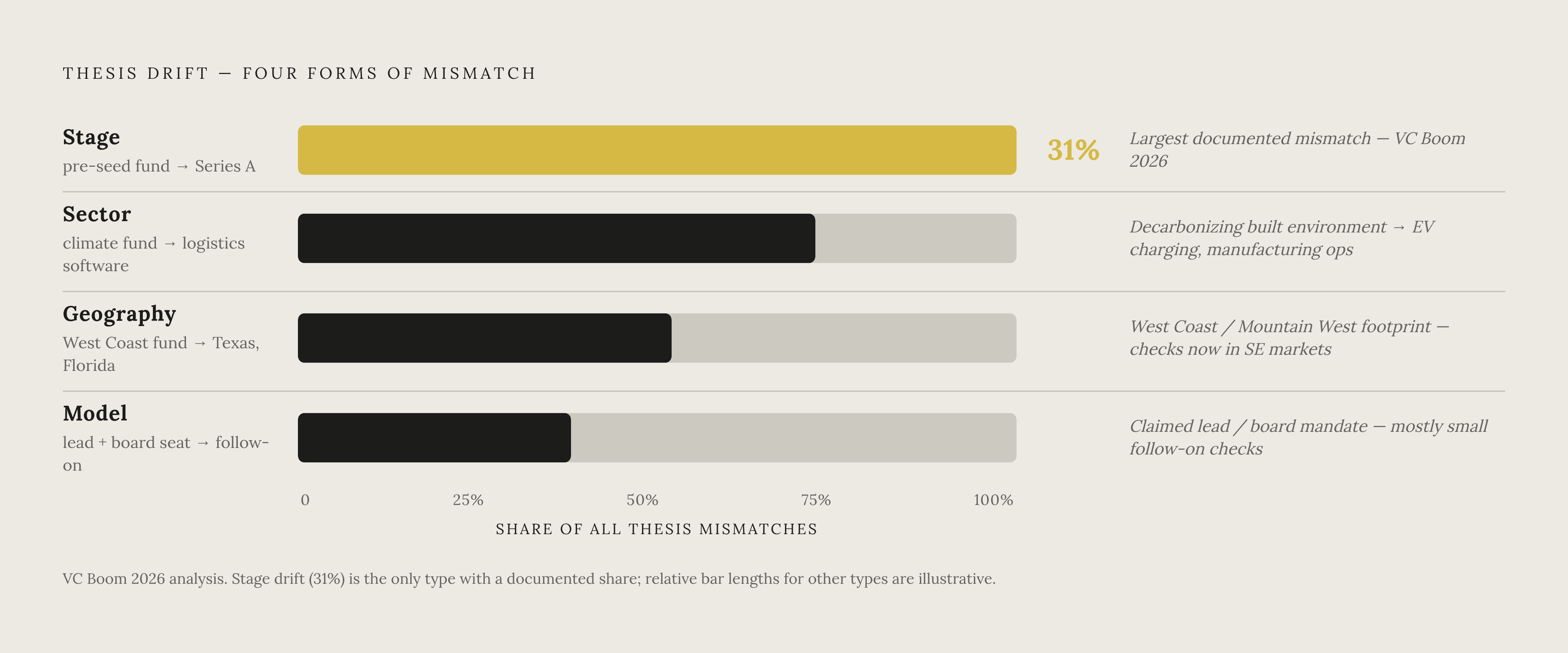
A fund describes itself as a "pre-seed generalist" but wrote the vast majority of its recent checks at Series A. This tends to happen after a fund raises a larger vehicle, or after later-stage deals start converting at a higher rate than the earlier-stage ones the fund originally built its reputation on. The economics of the fund change, but the thesis page keeps describing the old fund. VC Boom's 2026 analysis found that stage drift accounts for 31% of all thesis mismatches across active funds.
Sector drift runs close behind. A fund describes itself around one vertical, fintech or climate or health, and its recent checks tell a different story. The clearest illustration is a climate fund whose thesis page described its mission as "decarbonizing the built environment," while its last several deals were logistics software, manufacturing operations tools, EV charging networks, and financial infrastructure plays. A founder running an industrial emissions company spent weeks tailoring a pitch to this fund on the strength of its stated mission, only to be chasing a thesis the fund had already moved on from.
Geography drift appears when a fund's stated footprint, say West Coast and Mountain West, no longer matches where its last several deals actually closed. Founders move faster than fund websites do, and when enough of them relocate to Texas or Florida, a fund's real geographic center of gravity shifts before anyone updates the "where we invest" page.
Thesis drift takes four distinct forms, each with a different cause and a different signal, and together they account for most of the mismatches in the field.
Why drift is accelerating right now, not stabilizing
Two forces, operating at the same time, are pushing funds away from their stated mandates faster than in prior years: the concentration of capital into AI, and the shrinking number of surviving emerging managers. Neither force is slowing down, so drift is getting worse rather than correcting itself. It is getting worse.
Funds without a credible position in AI face pressure from their own limited partners to explain why not, and the straightforward response to that pressure is to drift the portfolio toward AI-adjacent or AI-enabled categories, regardless of what the fund's public thesis still says. This is not unique to any one fund; it is a market-wide pull exerted on any manager who needs to keep raising from the same LP base.
The emerging manager base has also thinned, and the funds that remain face pressure to chase conviction wherever it is forming rather than stay anchored to the stage or sector they originally built a track record around. Capital concentration compounds this: total venture funding rose while deal count fell in both 2024 and 2025. Average round sizes grew while the overall number of transactions shrank. Funds chasing fewer, larger opportunities are structurally more likely to wander from an early-stage or sector-specific mandate, because the biggest, highest-conviction deals in a given year do not arrive sorted neatly by a fund's original thesis.
A design flaw causes most of this, not any single partner's judgment: if a thesis has no measurable triggers, no specific KPIs or milestones tied to the original investment belief, it has no discipline to resist drifting, because no checkpoint forces a partner to ask whether a given deal still fits. The thesis was written without discipline built in from the start, not executed poorly by the people running it.
Winners compound the problem on their own. A generalist fund backs a wide spread of companies, a handful outperform in one sector, and partners start naturally prioritizing that sector in their time and attention. Their network responds by sending more deals that look like the winners. Two years pass, and the fund's actual character has changed completely, though no one ever made a single deliberate decision to change it. None of this means a fund that evolves its focus is behaving badly. A fund that refuses to adapt to a real shift in where value is forming can be making the wrong call just as easily as one that drifts without discipline. Drift is accelerating because the forces producing it, AI concentration, manager scarcity, compounding winners, are all intensifying at once rather than settling into a new equilibrium.
How thesis drift damages a founder's raise
A founder who builds her target list from stated fund mandates is not just working inefficiently. She is pitching the wrong story, to the wrong investors, at the wrong stage, and the cost compounds across the entire length of her raise.
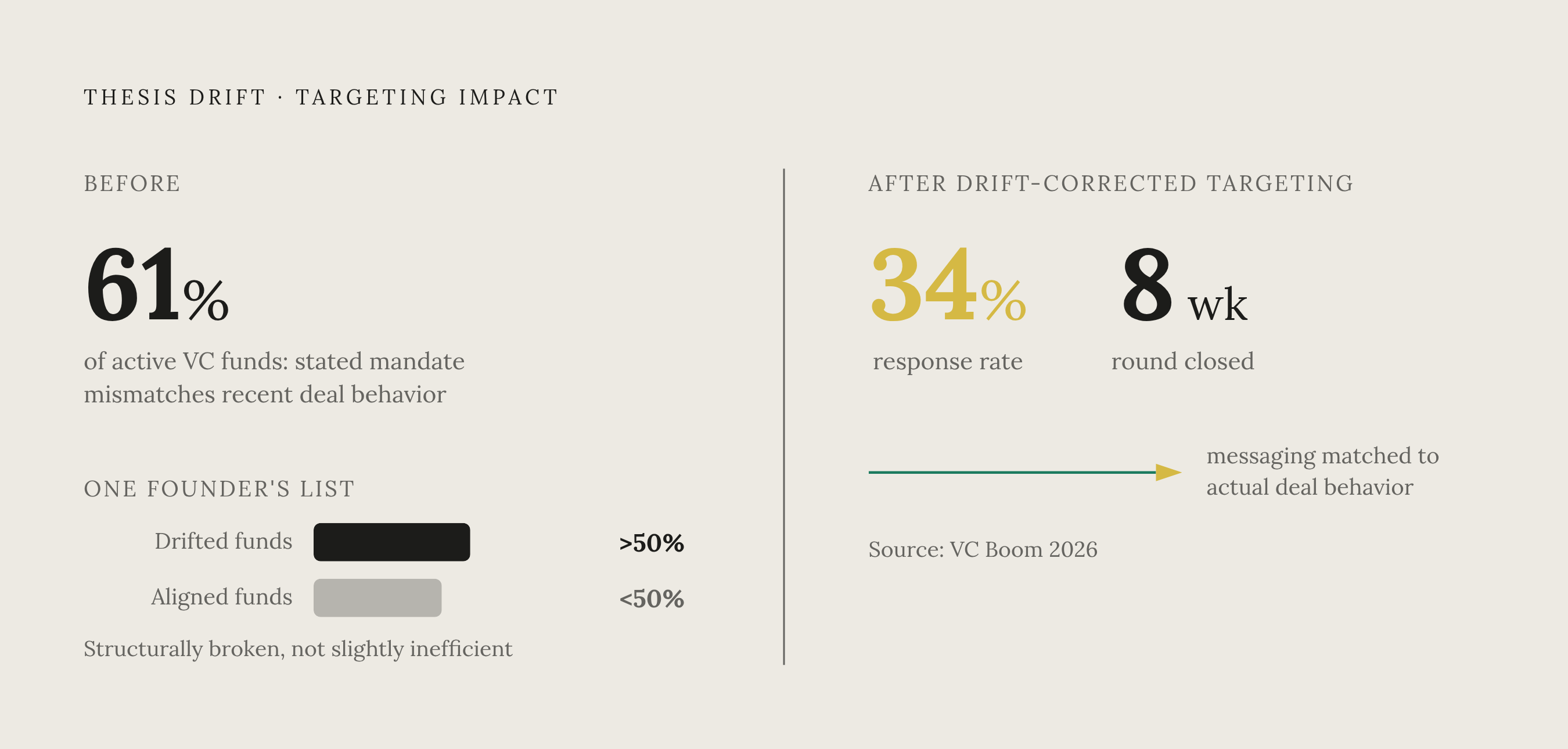
One founder's experience makes the scale of the damage concrete. She built a substantial list of funds to approach, checked each one against its actual recent deal behavior, and found that more than half had drifted meaningfully. She re-pitched a subset of the list with messaging matched to what those funds had actually been funding, and skipped the rest. Her response rate rose to 34%, and she closed her round in 8 weeks. The original list was not slightly inefficient. It was structurally broken, built on information that no longer described the funds on it.
The urgency behind this is not abstract. The traditional path from a seed round to a Series A has contracted sharply, and bridge rounds now make up nearly half of all seed financings, a sign that the straight line from seed to A that founders used to plan around no longer holds for most companies. Current round benchmarks show a wide gap between what seed and Series A investors expect: a Series A today expects substantial annual recurring revenue growing at a high multiple, and the seed round's real job is to buy the company enough time to clear that bar. A founder who spends weeks pitching a seed fund that has quietly drifted to Series A checks is not wasting a meeting. She is burning the exact runway her seed round was meant to buy her.
How to detect drift before building a target list
The method for catching drift does not require sophisticated research infrastructure. It requires discipline: a consistent habit of weighting recent deal behavior above anything a fund says about itself, applied across all four forms of drift before a single name goes on a target list. VC Boom's 2026 analysis found that 61% of active VC funds carry a meaningful mismatch between their stated mandate and their actual recent deal behavior. If you run a serious process, this filtering step is a baseline, not an optional refinement.
The starting move is to pull each fund's last 12 to 18 months of deals specifically, rather than its full portfolio history. A fund's 2019 deals say nothing about what it is backing in 2025, so pulling only the recent deals before building a target list is the one check that most changes whether a founder targets funds correctly.
Stage drift is caught by counting check sizes and round labels across those recent deals. If most of them sit one stage above the fund's stated mandate, treat the fund as having drifted and either re-categorize it or drop it from a seed-stage list entirely.
Sector drift is caught by looking for repetition rather than one-off exceptions. One consumer deal inside an otherwise B2B portfolio is noise. Four is a signal of a real sector shift, not noise. Six means the fund has effectively adopted a new thesis built around a different organizing logic than the one on its website, even if the website still says "fintech".
Geography drift is caught by mapping where the fund's recent portfolio companies are actually headquartered, not where the fund's own office sits. Founder migration moves faster than any fund can update its "where we invest" page, so a fund that calls itself West Coast but has written most of its recent checks into Texas and Florida companies is, for practical purposes, a different fund geographically than the one its website describes.
Model drift is caught by checking whether recent deals came with board seats and lead positions or were follow-on participation into rounds someone else led. A fund that claims to lead and take board seats but has mostly written small checks into other firms' rounds is not the lead investor a founder needs in order to actually close a round.
A thesis page not updated in 18 months or more, combined with a portfolio showing drift, means the stated mandate should be treated as stale rather than current, and a page's source metadata can often reveal exactly when it was last modified.
Tools exist, so you don't have to slog manually through portfolio pages. Harmonic indexes companies and tracks founder movements, hiring signals, and early traction, and VC teams already use it to monitor deal flow; founders can use the same underlying signals in reverse, to verify what a given fund has actually been doing in the market recently rather than what it claims. The output of all this filtering is a target list built from funds that have actually led a seed round in a founder's category within the last 12 months, which is a fundamentally different list than one built by matching thesis pages to category keywords.
Using drift detection to build the pitch and outreach
Once a founder knows what a fund actually funds rather than what it claims to fund, she can build her pitch narrative around the fund's real current thesis, which puts her in a stronger position than a founder pitching the stated mandate. If a fund branding itself a climate investor has in fact been writing its checks into logistics and manufacturing software, and you are building industrial operations technology, position your company against those actual portfolio comparisons, not against the climate label the fund no longer practices.
A deck exists to earn the next meeting, and a founder who has reverse-engineered a fund's real thesis from its recent deals can build a cold email and an opening slide that reference specific portfolio companies as pattern matches. Citing a fund's actual recent bets is a more credible opening move than citing language from its thesis page, because it tells the partner reading the email that the founder has already done the work of understanding what the fund is actually doing now.
This same filtering shapes the order in which a founder reaches out. A founder who has identified which investors are genuinely active in her category and stage over the last 12 months can prioritize her outreach by how recently each fund has deployed capital. A fund that has closed several deals recently in adjacent categories is more likely to be actively writing checks right now than one whose last relevant deal happened more than a year ago.
None of this replaces basic pipeline discipline, it sits alongside it. Most seed-stage founders manage well over 100 investor contacts at once, and not one reliable system tracks where each conversation stands. Tools such as Affinity score relationship strength from live communication metadata, not from manually logged notes, and Visible.vc structures pipeline tracking across stages of a raise. Both are more useful once the underlying list has already been filtered for drift, because neither tool tells a founder which funds are worth tracking in the first place.
Timing matters most right after Demo Day, where the entire goal is to book meetings for the following week. A founder who has already run her drift detection ahead of time can send a follow-up within days that references a fund's actual recent portfolio behavior instead of its website tagline, and that kind of specific, prepared follow-up signals a level of preparation that most founders competing for the same meetings never send. Fundraising is an operational process, and targeting precision is what separates a structured, drift-corrected process from months spent pitching the wrong investors the wrong story at the wrong time.

