Founder Tools That Surface Real-Time VC Check-Writing Activity
Track fund freshness, investment cadence, and thesis activity to find actively deploying VCs.

Real-time VC check-writing intelligence combines three signals, which are fresh fund capital, recent investments, and a live investment thesis. FundMomentum, deal databases, SEC filings, and what partners share each show a different part of that picture. Founders gain an edge by using those signals to build a short, up-to-date investor pipeline, then getting to know those investors before the raise begins.
Why the VC market's current shape makes investor targeting a data problem, not a network problem
Capital is concentrating into fewer, larger early-stage rounds, while Pre-Seed/Seed and Series A deal counts have fallen faster than Series C+ counts. A meaningful share of seed and Series A investment has flowed into mega-rounds, so aggregate dollars deployed do not describe the typical check a founder is pursuing. A market can have a lot of investment even when few investors are within reach.
A firm’s record of seed investing does not establish that it is still deploying at that stage, at a relevant check size, or within the same thesis. The active subset is narrower and moves quickly. Network access remains useful, but it cannot by itself distinguish a current deployment mandate from a historical interest. Targeting therefore starts with evidence of present activity.
How can founders tell which VCs are actively deploying rather than just taking meetings?
Most investor databases answer a retrospective question about who has invested before. Founders need a prospective answer about who has committed capital available and a mandate to deploy it. These are different research tasks by design. A fund that closed three years ago may still have a live website, an updated thesis page, and a Crunchbase profile even if it has no dry powder left.
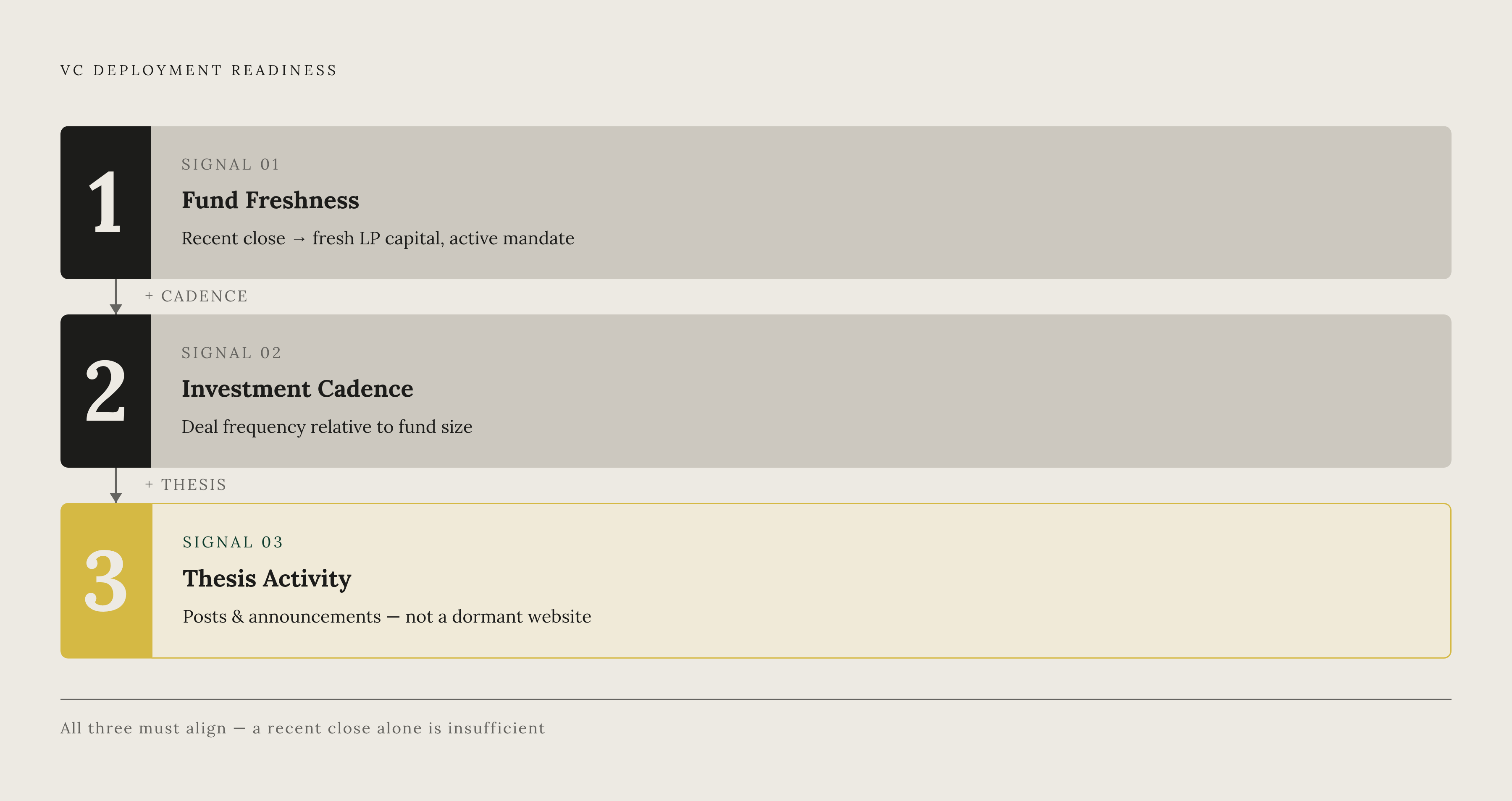
Deployment readiness has three parts, starting with how recently the fund closed. A new fund close brings fresh LP capital and a deployment mandate, making it a stronger structural signal than past participation in a round. Investment cadence adds the dimension of timing. Fund size correlates with deals per year, and micro VCs deploy more frequently than growth funds. Outreach is more useful when it reflects the firm’s investment rhythm rather than treating every apparently active investor as equally available.
Thesis activity is the third part, seen in what firms say publicly, what partners post, and what they announce about their portfolios. A published thesis may remain on a website after the firm’s attention has shifted elsewhere. Recent behavior helps distinguish a live thesis from a dormant one. An exploratory meeting alone resolves none of these questions. Together, capital availability, cadence, and thesis activity provide a more grounded definition of “active” than either a database entry or a willingness to meet.
The regulatory layer that makes real-time deal detection possible in the US
SEC Form D creates a public signal for US private capital raises subject to its filing requirement. The filing is due within 15 calendar days of the first sale, and it can precede a press announcement by days to weeks. Some companies never announce their rounds publicly. For those companies, the filing may be the earliest confirmable evidence of financing activity.
EDGAR makes these records searchable without an account or payment. Its search supports company name, state, and date, but does not natively filter by exemption type. Filtering for Rule 506(b) or Rule 506(c) exemptions helps tell venture-style raises apart from other private offerings, but founders have to do that step themselves in the raw search interface.
Form D discloses the total offering amount and number of investors, but not valuation, price per share, or investor names. A VC’s board seat can reveal involvement indirectly through the board listing, although that requires cross-referencing and remains imprecise. Parsing tools now separate operating-company filings from fund filings, resolve domains, and push structured signals into CRM tools. This makes the regulatory layer easier to use, but it does not remove the need to establish which investor participated.
Fund-freshness tracking: identifying VCs with a live deployment mandate
A recent fund close is the most reliable proxy for dry powder available without proprietary data. It creates both fresh capital and a mandate to invest that capital over a defined timeline. A partner can discuss a sector without making an investment, while a fund close establishes a new pool of committed capital.
FundMomentum tracks 949+ active VC and PE funds that have recently raised new capital. Its Investor Signals adds thesis tags, deployment pace, GP backgrounds, and founder preferences extracted from public GP communications. A newly raised fund belongs in a founder’s target pipeline only if its mandate is relevant to that founder.
FundMomentum also publishes the FM15, a semi-annual ranking of top emerging managers scored on LP trust, track record, thesis sharpness, and founder alignment. The ranking provides a curated shortlist of funds likely to be active and accessible. A two-year-old fund can still have meaningful dry powder if its deployment pace is slower. Recency remains the strongest single structural signal, but cadence determines how that signal should be read.
Deal-flow databases and aggregated tracking: reading check-writing activity from portfolio announcements
Recent portfolio investments show where available capital is actually going. No single announcement channel captures that activity with both complete coverage and immediate updates, so aggregation is essential. LinkedIn partner posts often show investments before databases update. SEC filings are legal evidence that financing has taken place, while VC firm blogs and newsletters explain the thesis behind an investment.
ShipShape.vc indexes over 30,000 active investors and uses language-processing search to compare what they say publicly about investing with the investments they make. PitchBook addresses a different depth of research. It provides the deepest LP and fund data at the institutional tier, with quarterly-refreshed LP data and more frequent deal-news updates. That depth supports institutional due diligence but is more than most seed founders need.
The practical output is a list of investors who recently led comparable rounds in the founder’s sector. A recent lead investment indicates an active thesis and makes further checks in that space more plausible. The investor becomes a warmer target because the founder has a concrete basis for relevance. A weekly 30-minute routine across a deal database, LinkedIn partner signals, and SEC Form D helps catch announcements before they reach industry press.
Pre-formation signals: detecting VC conviction before a check is written
Recent investments show decisions that have already been made, while pre-formation signals point to decisions still taking shape. VCs use trade registries, GitHub activity, patent filings, grant recipients, and domain registrations to find founders before conventional deal databases capture their companies. The categories they monitor indicate areas of interest. For founders, the opportunity is to identify investors building conviction in a category before that conviction becomes a publicly announced portfolio investment.
Evertrace is a founder detection engine used by 300+ VC funds as of 2026 to surface stealth builders before pitch decks exist. It monitors trade registries, GitHub, patents, research papers, domain registrations, and social co-founder searches. Its signals have a traceable chronology. The engine cross-references and timestamps them so investors can follow the path from a first digital footprint to company formation, gaining weeks or months over conventional deal-database sourcing.
Rather than searching for emerging companies, the founder looks for funds already paying attention to the relevant category. Public partner communications and portfolio patterns help make that interest legible. A fund’s use of a detection engine does not, by itself, establish its specific thesis, and category interest is not a commitment to invest. The useful distinction is between an investor whose thesis is already visible in completed deals and one whose communications show conviction forming ahead of deployment.
What real-time signals cannot do: the relationship gap that data alone does not close
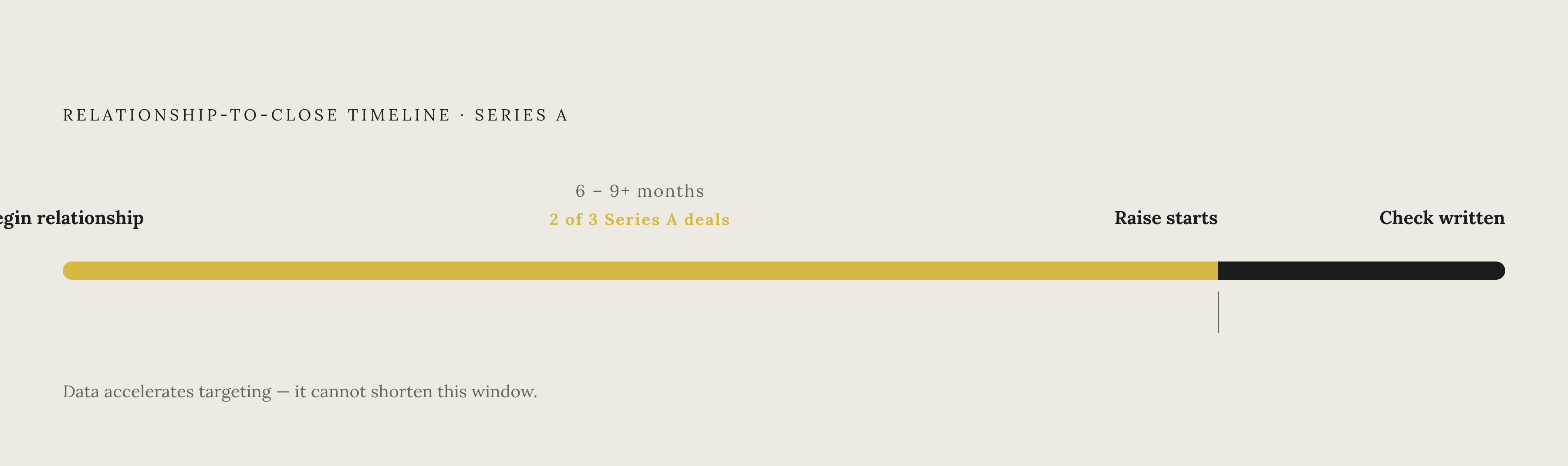
Data can identify an appropriate investor without creating the trust needed to secure a check. Two of three Series A deals now involve a founder known to the investor six to nine or more months before the raise. That interval cannot be compressed by better search.
Mathilde Collin, co-founder of Front (YC S14), describes this as getting to know potential investors before needing to raise money. The purpose is to avoid spending the raise itself getting to know the partner. This makes early targeting especially valuable for founders. A current, relevant shortlist allows relationship-building to begin before fundraising urgency dictates the schedule, rather than forcing a broad introduction campaign after capital becomes an immediate need.
The underlying data also leaves questions that require direct validation. Form D does not name the investors, so attributing a financing to a particular firm still requires cross-referencing and network research. Thesis fit can also depend on judgment. AI positioning can produce a large valuation premium or outright disqualification depending on execution credibility, which no database can settle in advance. The lesson is to use intelligence to concentrate relationship effort on a short, high-conviction list, not to treat evidence of activity as evidence of willingness to invest in a specific company.
Building the signal stack: how to combine these tools into a working pipeline discipline
The operating process begins with a quarterly refresh of fund freshness through FundMomentum and fund-close announcements. This establishes the top of the funnel around investors with evidence of fresh capital and a live mandate. Stage and sector fit then determine which of those funds warrant further attention, preventing a recent close from outweighing an obvious mismatch.
Reviewing deal activity each week keeps that first list up to date. Crunchbase Pro, LinkedIn partner signals, and SEC EDGAR Form D each show a different part of where checks are being written. The review connects capacity to observed behavior. Recent rounds like the one a founder seeks can move an investor up the list and give the founder a reason to reach out now, while firm blogs explain why the firm invested when a filing or database entry may leave that out.
Thesis-conviction tracking is ongoing, drawing on what partners share, VC firm blogs, and the pre-formation categories shown by Evertrace. Its role is to identify emerging alignment before a financing announcement makes that alignment obvious. The strongest targets satisfy all three criteria. They have evidence of dry powder, recent deployment in the relevant stage and sector, and a publicly legible thesis that matches the company. This creates an evidence-based ranking without pretending that a universal numerical score can predict a partner’s decision.
The resulting shortlist belongs in a CRM with a repeatable outreach cadence and relationship-building beginning six to nine months before the raise. Seed fundraising involves a large volume of investor outreach and first meetings, so maintaining that process is itself an operating task. Signals need a place in the workflow. When new evidence changes how well an investor fits, the pipeline must change with it.


