Five Fund Lifecycle Signals That Reveal Whether a VC Is Deploying Capital or Managing Its Existing Book
Five fund-lifecycle signals help founders spot whether a VC can actually write checks.

VC fund activity and check-writing signal intelligence starts with five signals, which are fund vintage, new-company investment cadence, response asymmetry, successor fund announcements, and between-funds timing. Together, they reveal whether an investor is deploying capital or managing its existing book. Founders who read them before outreach can distinguish genuine check-writing capacity from exploratory interest and avoid spending months on firms that cannot fund their round.
Why a VC's fund lifecycle position determines whether they can say yes at all
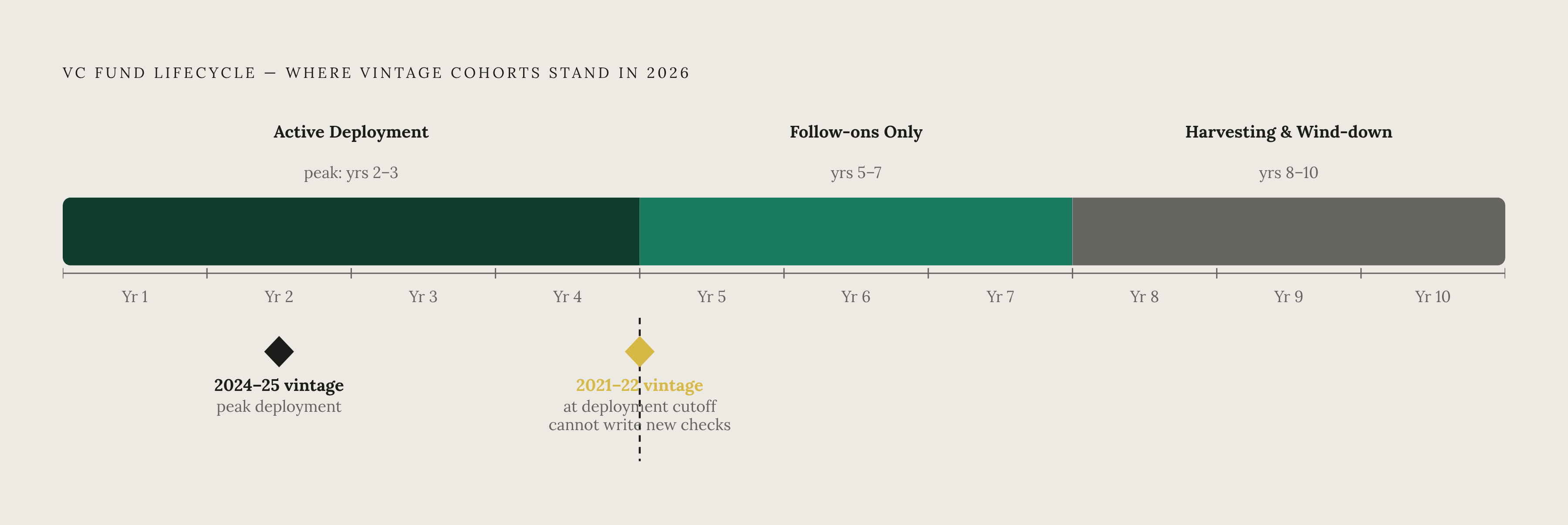
The Limited Partnership Agreement sets a fund’s investment period, typically the first four or five years of a roughly 10-year lifecycle. After that period closes, a general partner generally cannot invest in a new company, even if the partner strongly supports the deal. Portfolio management, harvesting, and wind-down occupy the remaining years.
A fund that led headline rounds in 2022 may have committed 60 to 70% of its capital in years two and three, leaving the rest reserved for existing portfolio companies. From outside, that fund can resemble an active investor because its partners still take meetings, publish commentary, and attend conferences. An enthusiastic partner can therefore spend weeks in diligence before a deal stalls at the fund’s contractual boundary. Founders need to check that a fund can invest before they count its interest as progress.
Why 2021–2022 vintage funds make this problem acute right now
Funds that closed in 2021 or 2022 are a particularly common hazard for founders raising in 2026. This cohort sits inside or just beyond a standard three-to-five-year investment window, where new investments become selective, rare, or contractually unavailable. The calendar is only part of the constraint. Partners may also be managing largely unrealized portfolios while asking the same limited partners to commit to a successor fund. Remaining reserves and partner attention then serve obligations that predate the founder’s pitch.
Global LP commitments to new venture funds fell sharply in 2025, making that successor conversation harder. A manager with paper gains but few distributions has a difficult fundraising case, which draws attention toward LP relations and reduces attention to new-company sourcing. This is a mismatch between the founder’s financing deadline and the investor’s deployment window. By contrast, funds that closed in 2024 or 2025 generally have more undeployed capital and stronger pressure to establish portfolio velocity for LP reporting, making them higher-priority targets.
Signal one: fund vintage year and what the deployment calendar tells you
Fund vintage is the most useful first filter because it places the vehicle on a deployment calendar before any conversation begins. The working heuristic is years one through four for active deployment, years five through seven for follow-ons, and years eight through ten for harvesting. Funds usually write the most checks in years two and three. This is a filter, not a guarantee. It identifies where new-company investment is most plausible without treating the fund’s full lifespan as an open invitation to pitch.
SEC Form D filings on EDGAR show dates of first sale and amounts sold, so the public can see when a fund has raised money. A first sale is not a final close. Crunchbase and PitchBook track fund closes, and firm announcements and trade coverage give more dates. Those records distinguish a 2024 or 2025 vehicle building its portfolio from a 2019 vehicle in follow-on mode in 2026. A 2023 vintage should also be checked for active deployment, even if the firm has been around for years.
A recent fund can pass because of thesis mismatch, reserved follow-on capital, or a full internal pipeline. Recycling provisions also complicate the calendar by allowing some funds to reinvest early exit proceeds, usually within capped amounts and the active investment period. The relevant question remains whether that particular vehicle can allocate capital to a new company during the founder’s raise.
Signal two: new-deal cadence versus follow-on activity only
Recent investment announcements show deployment capacity only when they include new portfolio names. A follow-on round puts money into a company the fund already owns, so it demonstrates portfolio support. The distinction is easy to miss in deal counts. Founders should check each recent investment against the fund’s prior portfolio to see which commitments went to new companies and which went to companies it already backed.
Actively sourcing funds typically invest in 2 to 4 new companies per quarter. Irregular gaps of four or more months between new-company investments warn of a vehicle that is winding down, fully deployed, or between fundraises. The gap establishes a reason to investigate before allocating outreach time. Crunchbase and PitchBook are useful here because the task is to trace investment history.
Partner activity can help interpret that record. When partners talk about sectors the firm wants to enter, hold office hours, and attend demo-day events, these are signs that the firm is actively sourcing. Content focused on portfolio wins and exits, coupled with an absence from pitch events, supports a portfolio-management reading. Public enthusiasm becomes more persuasive when the investment record shows new names entering the portfolio.
Signal three: response asymmetry between new inbound and existing portfolio
Response asymmetry reveals where a fund’s remaining capital creates urgency. As the investment period ends, more of the reserves go toward existing companies, so decisions on their follow-ons may be quick while replies to new inbound are slow or never come. The comparison is more informative than silence alone. A slow reply can look like caution about the market as a whole even when the same partnership is quick to act within its portfolio.
The texture of diligence supplies another clue. Early-fund partners tend to ask exploratory questions about what a company does and why, while late-period conversations may stay at general market questions and avoid terms. A fully deployed firm can still value the relationship for its next vehicle. Founders should distinguish an evaluation that advances toward a check from a conversation that only builds familiarity.
A founder can ask how long the last two new investments took from first meeting to term sheet, then compare that with the last two follow-on decisions. Portfolio founders provide the other side of that comparison. If they describe a highly responsive partner while an outside founder waits through weeks of silence, reserved-capital stewardship becomes a stronger explanation. This signal is stronger when vintage and deal cadence already suggest that the investment period is near its end.
Signal four: successor fund announcement — and what its absence tells you
A successor fund announcement reveals more than fundraising success. It shows that enough of the prior vehicle’s capital has been committed for the firm to ask LPs for another allocation, while a completed close shows that the new vehicle has capital. A firm seeking commitments is not in the same position as one with a closed successor fund. A 2021 or 2022 vehicle with no announced successor calls for a closer look because firms usually start raising again before the prior vehicle winds down.
Kleiner Perkins raised a new fund in March 2026, with capital split between late-stage growth and early-stage startups. That raise illustrates the transition from a substantially deployed prior vehicle toward new investment capacity. Index Ventures raised capital across a seed fund, a venture fund, and a top-up to its 2024 growth fund following its stake in Wiz, which Google acquired. Distributions can unlock the next allocation of capital. The Index example shows why realized returns, rather than paper gains alone, can strengthen LP willingness to commit again.
Accel came back to market only four months after closing Leaders Fund V in April 2026, while Sequoia raised an expansion fund in Q2 2026 that was nearly double the size of its comparable 2022 vehicle under Alfred Lin and Pat Grady’s co-stewardship. Hyperion Ventures, a small Fund I focused on deeptech, deployed capital across seven companies in its first six months. Founders should use EDGAR filings and firm announcements to identify the relevant vehicle, then examine its new-company cadence rather than borrowing confidence from the firm’s overall fundraising profile.
Signal five: the between-funds paralysis window and how to distinguish it from end-of-fund wind-down
A firm raising its successor can enter a temporary deployment paralysis even when it intends to keep investing for years. LP meetings, roadshows, and due diligence responses absorb partnership attention, slowing new sourcing while small or obligatory follow-ons continue. This differs from a vehicle reaching its end. In a wind-down, the old fund’s new-investment capacity has expired. Between funds, capacity can return once the successor closes and its deployment clock starts.
Partners may need several months to put the new thesis into practice, establish LP reporting cadences, and rebuild the internal pipeline. A recent close followed by no new-company investments is therefore a timing signal, especially when the latest new names predate the announcement. The firm may be ramping. That interpretation prevents a founder from confusing future potential with readiness to act on the current round.
The appropriate response is to calendar a return. Outreach in the months following a close can reach partners as their motivation to build the new portfolio strengthens. Fundraising windows make this distinction consequential. Spending the spring window pursuing a firm occupied with its own raise consumes time that cannot be recovered simply by shifting the conversation into fall. A promising future investor can still be the wrong target for a financing deadline now.
How can founders combine these signals before building an outreach list?
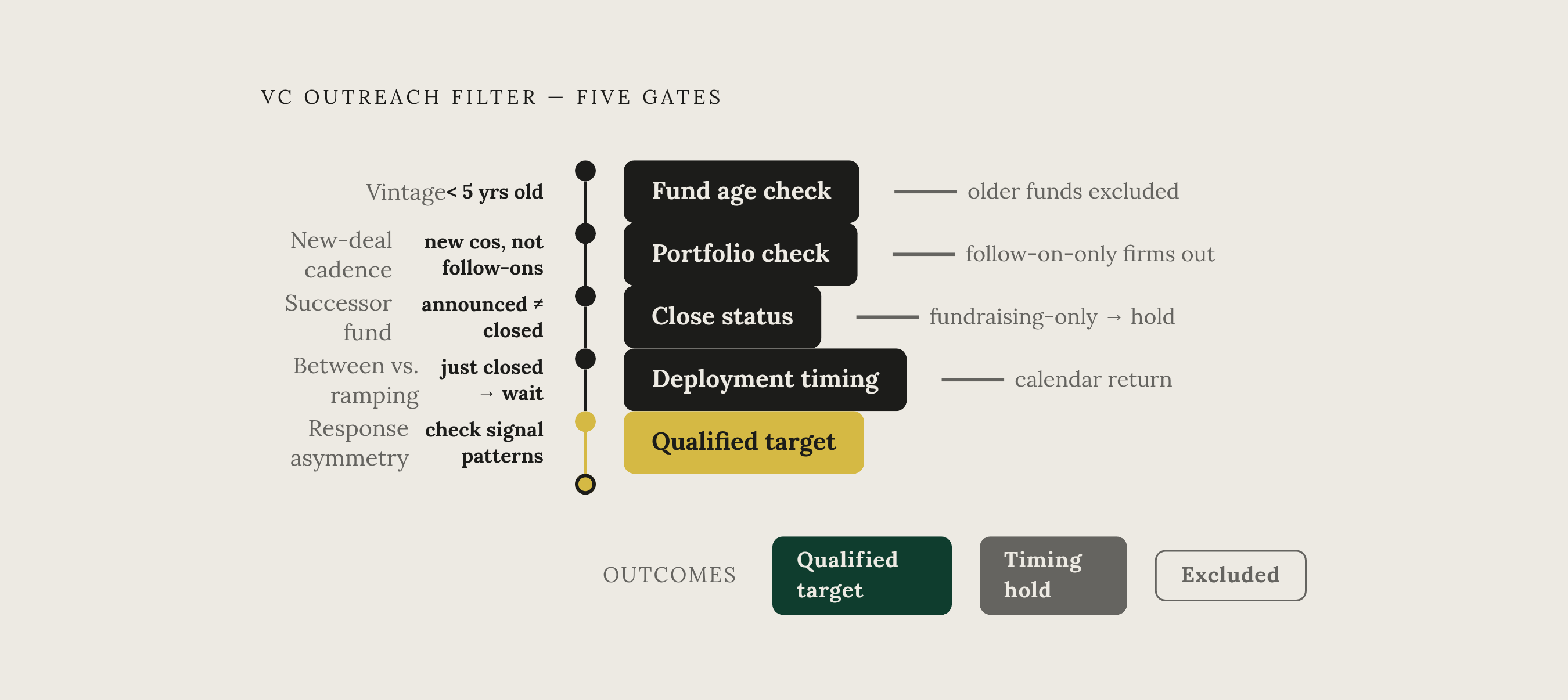
Start with vintage and remove vehicles older than five years from the primary list unless a successor has been announced. Next, check whether the fund has recently backed new companies as well as making follow-ons. Check the successor’s status next, distinguishing an announced fundraising effort from a close that creates a new pool of capital.
Then assess whether the firm is between funds or still ramping after a close. A timing problem calls for outreach several months post-close. Check response asymmetry only for firms that pass those filters based on public data. As the process advances, each gate answers a narrower question, moving from contractual plausibility to observed deployment and finally to the founder’s own interaction.
The tools have distinct roles in that workflow. EDGAR supplies first-sale and fundraising records, while Crunchbase and PitchBook help trace closes, investment cadence, and new portfolio names. Firm press releases and trade coverage show when a successor has been announced, and partners’ activity on LinkedIn gives clues about how they spend their time. The useful output is a qualified target, a timing hold, or a firm excluded from the current raise.
A recent vintage with new-company investments, a coherent successor-fund position, no paralysis window, and responsive diligence is structurally qualified regardless of fund size. A large firm failing several of those tests is not rescued by its reputation. Institutional allocators already check vintage, deployment pace, distributions, and LP re-up rates as a regular part of diligence. Founders can apply the same discipline to targeting.


