LP Capital Call Schedules and VC Liquidity Constraints
Missed LP capital calls can delay or kill a deal, even after the VC says yes.

A term sheet is a promise. A wire is a fact. Founders who treat those as interchangeable are negotiating half-blind, because the gap between a VC saying yes and a VC actually sending money isn't a technicality: it's a legal and financial structure with its own clock, its own failure modes, and its own tells.
A capital call is a formal, legally binding request from a fund's general partner to its limited partners, asking them to wire a specific slice of the money they already promised. It's an exercise of a contractual right written into the fund's limited partnership agreement, and LPs who ignore it face real consequences, covered below.
Most founders miss the distinction between committed capital and paid-in capital. When an LP signs onto a fund, they promise a dollar figure they'll contribute over the fund's life. That's committed capital, and none of it sits in an account waiting to be spent. Paid-in capital is the slice the GP has actually called and the LP has actually wired. Until the call goes out, a fund's advertised assets under management is largely a number on a subscription agreement, not cash.
Elizabeth Yin, co-founder of Hustle Fund, said VCs actually have very little cash on hand. That single line should reframe how a founder reads investor enthusiasm. A partner loving your deck and a partner having callable capital ready to fund your round are two separate questions, and founders who collapse them into one lose momentum they never needed to lose.
The structure exists because both sides want the same thing for different reasons. GPs don't want idle cash dragging down returns while they wait on the right deal. LPs want their capital working elsewhere, in short-term instruments, in other funds, in their own operating business, for as long as possible before it's needed. Calling capital only when there's a specific use for it keeps both sides efficient. It also means every dollar a VC deploys traveled through a legal request first, whether or not the founder ever sees that request happen.
Capital call notice contents and how their terms constrain GP behavior
A capital call notice is not a form email dashed off between meetings. It has to state the exact dollar amount owed by each LP, the due date, wire instructions, the section of the limited partnership agreement authorizing the call, and how the call affects that LP's remaining unfunded commitment.
A trade group representing institutional limited partners publishes standard templates for these notices, and sophisticated GPs use them, because institutional LPs (endowments, pension funds, funds-of-funds) cross-check every field against their own records before authorizing a wire. A sloppy or vague notice slows the whole chain down, and slow is the one thing a hot deal can't afford.
The LPA also limits what a call can pay for. Permitted uses typically run to funding a new portfolio investment, funding a follow-on into an existing company, covering management fees and fund operating expenses, or repaying short-term borrowing that bridged a deal before the call went out. If a GP's stated purpose doesn't map onto one of those categories, an institutional LP pushes back before wiring, not after. That friction is a real, underappreciated source of delay in rounds that already look closed from the founder's side of the table.
So when a founder hears "we're in," there's still a legal chain of custody ahead, requiring an authorized call, a matching permitted use, and LPs who agree the paperwork lines up. Skipping any link in that chain leaves the yes standing as a yes on paper only.
How subscription credit lines let GPs move faster
Most funds don't wait on LP wires when speed matters. They lean on subscription credit lines, sometimes called capital call facilities, where a bank or non-bank lender extends a revolving line secured by the fund's uncalled LP commitments. The fund draws on the line, closes the deal same-day, and issues the capital call to LPs afterward, using their wires to repay the facility rather than to fund the deal directly.
These lines typically bridge a fund for weeks to several months. That window is what lets a GP move on a hot deal without waiting on wires from a dozen or more institutional LPs scattered across time zones and internal approval committees. Over 90% of private equity funds use some form of subscription facility, standard infrastructure that most GPs now rely on. This is standard infrastructure, not a clever workaround.
It's also a distortion. A subscription line delays the actual capital call, which shortens the measured period during which LP money is officially "at work" in the fund. IRR is a time-weighted metric, so shortening that clock inflates the number without changing a single underlying deal. GPs leaning on these facilities can report IRRs 6 to 11 percentage points higher than the deal performance alone would justify. A headline return, in other words, can say more about how a GP timed its capital calls than about how good its portfolio actually is, and founders reading a track record off a fund's website should treat that number with exactly the skepticism they'd apply to a startup's own vanity metric.
The LP liquidity drought that has been reshaping VC check-writing since 2022
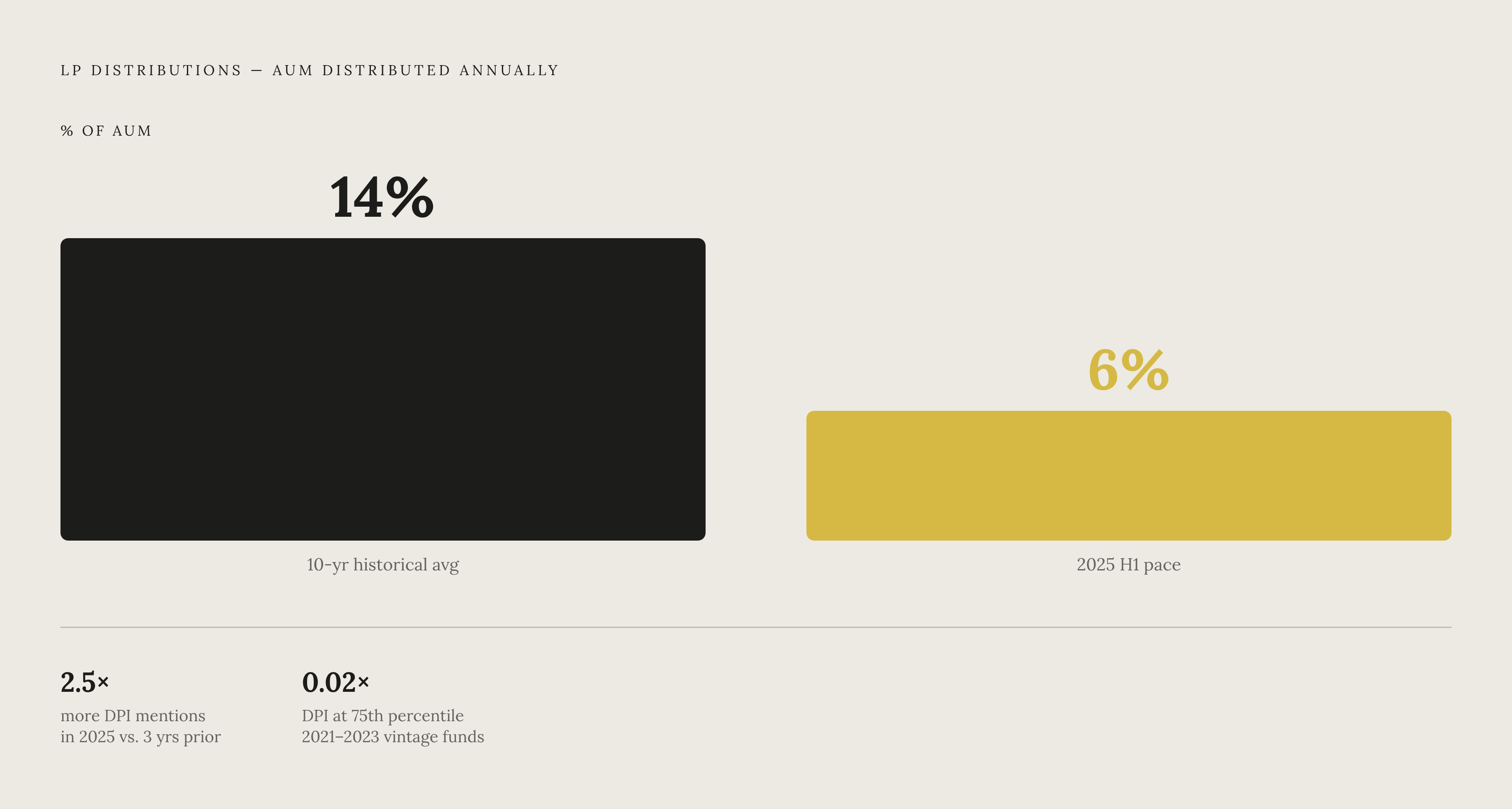
LPs get paid back through distributions: IPOs, acquisitions, and secondary sales that return cash to the fund, which the GP then passes along. The channel had mostly dried up since 2022, and this shift in VC cash sources has substantially changed how VCs behave, appearing even where it is not visible in a pitch meeting.
LP distributions fell to roughly 6% of assets under management in the first half of 2025, against a ten-year average closer to 14%. That's less than half the historical pace of cash coming back to LPs, and it's held for multiple years running, not one bad quarter that self-corrects.
LPs' pursuit of DPI reflects this consequence, and DPI is the metric LPs now chase most. DPI, Distributed to Paid-In capital, measures actual cash returned against actual cash invested, not paper markups on a quarterly report. As of 2025, the share of LPs naming DPI their most critical performance metric ran 2.5 times higher than it was three years earlier. LPs have stopped accepting markups as a substitute for cash. They want the money back, full stop.
Vintage-level data makes the scale hard to argue with. Across a sample of 835 funds holding $118 billion in commitments, the 2021 through 2023 vintages show near-zero distributions, just 0.02x DPI at the 75th percentile. Meanwhile the ratio of cash to total value held by LPs dropped from 16% in 2019 to 11% in 2025. LPs are paper-rich and cash-poor: sitting on markups they can't spend, still owing commitments they can't skip.
LP default risk and penalty mechanics as a hidden pressure on VC timing
Missing a capital call is not a minor scheduling slip. The LPA is a binding contract, and a missed wire puts the LP in default under its terms, with consequences that escalate fast and without much sympathy.
Most LPAs build in a cure period after the due date, but penalty interest accrues during that window, typically in the double digits annually. On a large commitment, that's a real, immediate cost, not a rounding error buried in a footnote.
If the LP still doesn't cure, the GP holds the contractual right to force a sale of the LP's interest at a steep discount to fair market value. The harshest remedy on the books is full forfeiture: the LP's paid-in capital and any accrued gains get canceled outright, and in most Delaware-governed funds, this happens without a court ever getting involved.
Case law backs the teeth of this up. In Vinton v. Grayson, a court upheld staged forfeiture provisions written into the operating agreement, while also finding the GP could separately pursue breach-of-contract damages on top of that forfeiture. Institutional LPs know this case, and it's a large part of why they treat every capital call notice like an actual bill rather than a friendly reminder. The penalty structure is enforceable language with real financial consequences built into the exhibit. It's what makes committed capital dependable enough to build an entire investment strategy around. GPs can rely on the schedule holding as a result.
The secondary market as a liquidity release valve
When distributions dry up but LPs still need cash, they sell fund stakes on the secondary market instead of waiting on the GP for an exit. Secondary transactions reached roughly $162 billion in 2024, about 45% higher than the year before, and LP-led sales drove a further surge in 2025, accounting for 54% of total secondaries volume.
Set against the traditional exit market, the scale gets clearer. Over the twelve months ending in June 2025, venture secondaries volume has grown substantially relative to traditional exit channels. The side-door liquidity market has expanded well beyond its original supplementary role, and that shift alone says how starved the exit environment has become.
Who's selling matters as much as how much. Endowments, foundations, family offices, and asset managers each accounted for roughly 20% of secondary sellers, and these are the same institutions that back most early-stage venture funds. When they offload stakes for cash, the pressure comes from the core of the LP base that funds the entire venture ecosystem, not from its edges.
Pricing tells the rest of the story. High-quality portfolios trade around 90 cents on the dollar, a real recovery from the steeper discounts seen earlier in the downturn. Still, nobody sells a good asset at a real discount because they found a great trade. They sell because they need cash now, and 90 cents today beats an uncertain distribution three years out.
VC deployment in 2025–2026 given these constraints
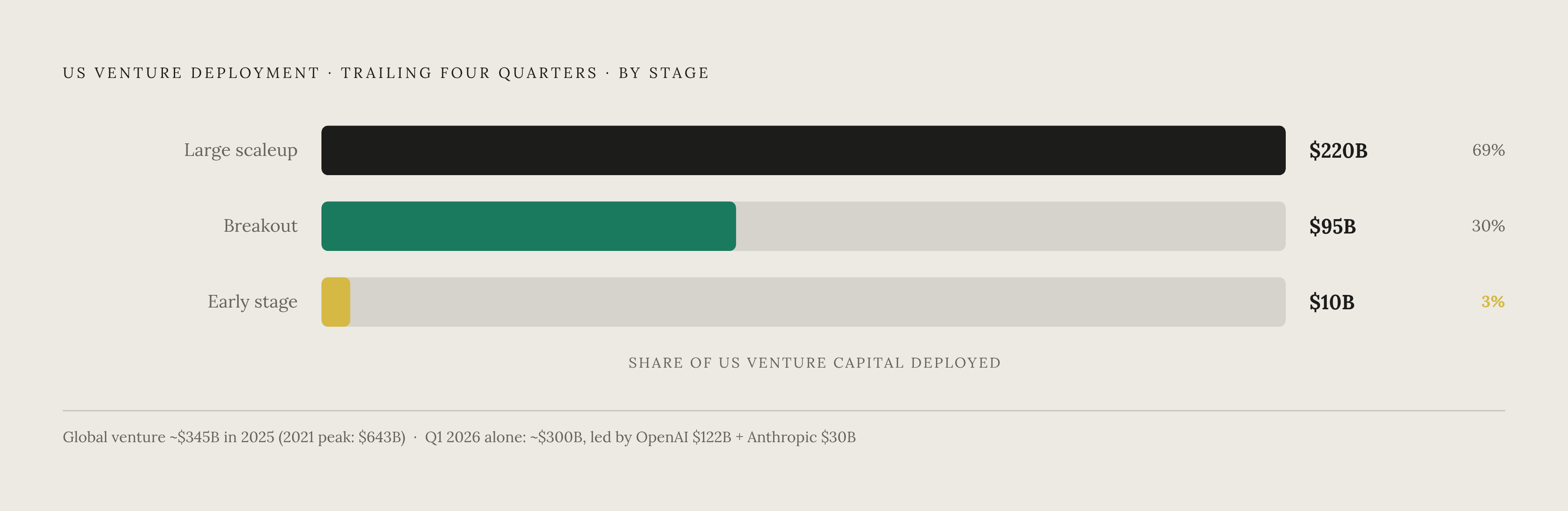
Global venture investment in 2025 came in at roughly $345 billion, up from the 2023 trough of $285 billion but still well short of the 2021 peak of $643 billion. Deployment has recovered. It has not returned to anything resembling the old normal, and founders treating this as a return to 2021 conditions are making the single most common mistake in the market right now.
Then Q1 2026 broke the pattern. Roughly $300 billion got deployed across about 6,000 startups in a single quarter, more than 150% higher than both the prior quarter and the same quarter a year earlier. Two deals anchor most of that jump: OpenAI closing $122 billion and Anthropic raising $30 billion, both inside the same three-month window.
That concentration runs through the whole market, including outside the mega-rounds. AI captured a dominant share of total global venture funding in Q1 2026. Valuations moved accordingly: AI companies at later stages commanded meaningfully elevated premiums over non-AI businesses in 2025, and earlier-stage AI rounds also saw significant valuation premiums over comparable non-AI deals.
The money is also piling into fewer, larger checks, and that concentration is the direct downstream effect of everything above. A disproportionate share of all US venture dollars in 2025 went to a very small number of companies at the top of the valuation distribution. Looking at the trailing four quarters, The overwhelming majority of capital landed in large scaleup rounds, a much smaller share went to breakout-stage rounds, and early-stage startups captured only a sliver of the total. GPs sitting on capital that's harder to call, LPs demanding cash back before re-upping, credit lines that reward speed and conviction: all of it pushes dollars toward the largest, most legible bets. Smaller, earlier checks require patience from the LP base, and patience is out of stock right now. That's the actual story of 2025 to 2026, not an AI boom in isolation but an AI boom colliding with an LP base that's rationing its trust.
Applying This Knowledge to a Structured Raise
None of this stays abstract once a founder is mid-raise. It changes which questions get asked of a prospective lead, and founders who skip these questions are negotiating with half the information available to everyone else at the table.
Fund age is one of the most useful signals around, and it's the one founders check least. A fund in years four or five of its investment period is near the tail end of when most of its capital gets called, so its remaining capacity to write new checks shrinks by the month. A fund in years one or two still has substantial LP-backed runway sitting behind it. Asking, even indirectly, when a fund closed and how much it has already deployed tells a founder whether a yes can turn into a wire quickly or whether it sits in queue behind other commitments.
Vintage matters for a related but separate reason. A fund that closed in 2021 or early 2022 is very likely sitting on LPs who are paper-rich and cash-poor, the exact profile the DPI data above describes. Those LPs are less inclined to re-up into that GP's next fund, which constrains the GP's ability to raise a follow-on vehicle and often pushes it toward caution with whatever's left in the current one.
A GP's LP base matters too, and founders rarely ask about it directly enough. A GP leaning heavily on endowments and foundations, categories that have each represented a meaningful share of secondary market selling, is very likely facing more liquidity pressure than one backed by family offices or corporate strategics with different cash needs and longer time horizons.
When a VC touts speed as a selling point, ask what's actually making that speed possible. The answer changes what the promise is worth. A firm using a subscription line to close fast offers a real advantage, but that facility is a bridge, not a permanent source of capital, and it eventually gets repaid through an actual capital call to actual LPs. Confirm the real distance between a signed term sheet and wired funds, and don't mistake speed for a personality trait of the firm when it might just be a credit facility running against a short-term clock. The capital was always going to arrive through the same legal chain, line of credit or not. Knowing exactly where a fund sits in that chain is what separates reading the signal correctly from reading it the way you hoped it would read.

